
Textbook Question
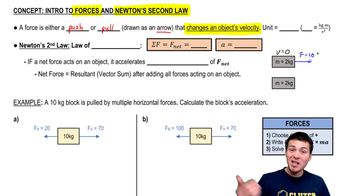
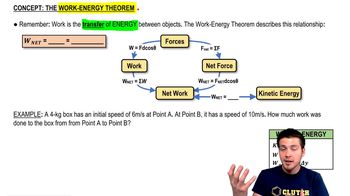
A 150 g particle at x = 0 is moving at 2.00 m/s in the + x - direction. As it moves, it experiences a force given by Fₓ = (0.250 N) sin (x/2.00 m). What is the particle's speed when it reaches x = 3.14 m?

 Verified step by step guidance
 06:54
06:54
 04:10
04:10 08:25
08:25A 150 g particle at x = 0 is moving at 2.00 m/s in the + x - direction. As it moves, it experiences a force given by Fₓ = (0.250 N) sin (x/2.00 m). What is the particle's speed when it reaches x = 3.14 m?
A 1000 kg elevator accelerates upward at 1.0 m/s² for 10 m, starting from rest. How much work does the tension in the elevator cable do on the elevator?
Susan's 10 kg baby brother Paul sits on a mat. Susan pulls the mat across the floor using a rope that is angled 30° above the floor. The tension is a constant 30 N and the coefficient of friction is 0.20. Use work and energy to find Paul's speed after being pulled 3.0 m.
A pile driver lifts a 250 kg weight and then lets it fall onto the end of a steel pipe that needs to be driven into the ground. A fall from an initial height of 1.5 m drives the pipe in 35 cm. What is the average force that the weight exerts on the pipe?
The energy used to pump liquids and gases through pipes is a significant fraction of the total energy consumption in the United States. Consider a small volume V of a liquid that has density ρ. Assume that the fluid is nonviscous so that friction with the pipe walls can be neglected. An upward-pushing force from a pump lifts this volume of fluid a height h at constant speed. How much work does the pump do?
A 70 kg human sprinter can accelerate from rest to 10 m/s in 3.0 s. During the same time interval, a 30 kg greyhound can go from rest to 20 m/s. What is the average power output of each? Average power over a time interval ∆t is ∆E/∆t.