Ch 09: Work and Kinetic Energy
Knight Calc - Physics for Scientists and Engineers 5th Edition
Knight Calc5th EditionPhysics for Scientists and EngineersISBN: 9780137344796Not the one you use?Change textbook
Chapter 9, Problem 45

A 150 g particle at x = 0 is moving at 2.00 m/s in the + x - direction. As it moves, it experiences a force given by Fₓ = (0.250 N) sin (x/2.00 m). What is the particle's speed when it reaches x = 3.14 m?

Verified step by step guidance
1
Step 1: Recognize that the work-energy principle applies here. The work done by the force on the particle will result in a change in its kinetic energy. The work-energy theorem states: ΔK = W, where ΔK is the change in kinetic energy and W is the work done by the force.
Step 2: Write the expression for kinetic energy. The kinetic energy of the particle is given by K = (1/2)mv², where m is the mass of the particle and v is its velocity. The change in kinetic energy is ΔK = (1/2)m(v_f² - v_i²), where v_f is the final velocity and v_i is the initial velocity.
Step 3: Calculate the work done by the force. The work done by a variable force is given by W = ∫ Fₓ dx, where Fₓ is the force as a function of position x. Substitute Fₓ = (0.250 N) sin(x / 2.00 m) into the integral: W = ∫ (0.250 N) sin(x / 2.00 m) dx, with limits of integration from x = 0 to x = 3.14 m.
Step 4: Solve the integral for work. The integral of sin(ax) is (-1/a) cos(ax), where a is a constant. Here, a = 1 / (2.00 m). Perform the integration and evaluate the result at the limits x = 0 and x = 3.14 m.
Step 5: Use the work-energy theorem to find the final speed. Substitute the calculated work W and the given mass m = 150 g = 0.150 kg into the equation ΔK = W. Solve for v_f using v_f² = v_i² + (2W / m), where v_i = 2.00 m/s. This will give the final speed of the particle.

Verified video answer for a similar problem:

This video solution was recommended by our tutors as helpful for the problem above.
Video duration:
13m
Was this helpful?

Key Concepts

Here are the essential concepts you must grasp in order to answer the question correctly.

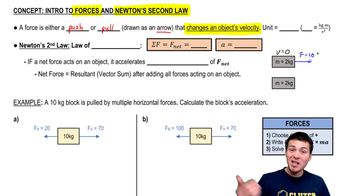
Newton's Second Law of Motion

Newton's Second Law states that the acceleration of an object is directly proportional to the net force acting on it and inversely proportional to its mass. This relationship is expressed mathematically as F = ma, where F is the net force, m is the mass, and a is the acceleration. Understanding this law is crucial for analyzing how the force acting on the particle affects its motion and speed.
Recommended video:
Guided course
06:54
Intro to Forces & Newton's Second Law

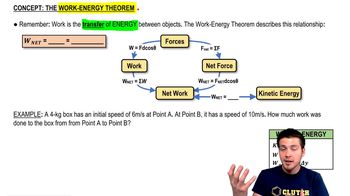
Work-Energy Principle

The Work-Energy Principle states that the work done on an object is equal to the change in its kinetic energy. In this scenario, the force acting on the particle does work as it moves from x = 0 to x = 3.14 m, which will change its speed. This principle allows us to relate the force to the particle's speed by calculating the work done over the distance traveled.
Recommended video:
Guided course
04:10
The Work-Energy Theorem

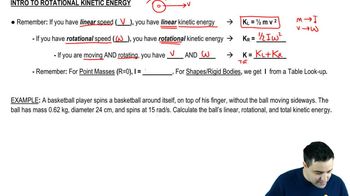
Kinetic Energy

Kinetic energy is the energy an object possesses due to its motion, calculated using the formula KE = 0.5mv², where m is the mass and v is the velocity of the object. As the particle moves and experiences a force, its kinetic energy will change, which can be analyzed to determine its final speed at a given position. Understanding kinetic energy is essential for solving the problem and finding the particle's speed at x = 3.14 m.
Recommended video:
Guided course
06:07
Intro to Rotational Kinetic Energy
Related Practice
Textbook Question

Doug uses a 25 N horizontal force to push a 5.0 kg crate up a 2.0-m-high, 20° frictionless slope. What is the speed of the crate at the top of the slope?

2
views

Textbook Question

A ball shot straight up with kinetic energy K₀ reaches height h. What height will it reach if the initial kinetic energy is doubled?

Textbook Question

A 1000 kg elevator accelerates upward at 1.0 m/s² for 10 m, starting from rest. How much work does the tension in the elevator cable do on the elevator?

1
views
Textbook Question

Susan's 10 kg baby brother Paul sits on a mat. Susan pulls the mat across the floor using a rope that is angled 30° above the floor. The tension is a constant 30 N and the coefficient of friction is 0.20. Use work and energy to find Paul's speed after being pulled 3.0 m.

1
views
Textbook Question

A pile driver lifts a 250 kg weight and then lets it fall onto the end of a steel pipe that needs to be driven into the ground. A fall from an initial height of 1.5 m drives the pipe in 35 cm. What is the average force that the weight exerts on the pipe?

1
views
Textbook Question

The energy used to pump liquids and gases through pipes is a significant fraction of the total energy consumption in the United States. Consider a small volume V of a liquid that has density ρ. Assume that the fluid is nonviscous so that friction with the pipe walls can be neglected. An upward-pushing force from a pump lifts this volume of fluid a height h at constant speed. How much work does the pump do?

1
views