Ch 09: Work and Kinetic Energy
Knight Calc - Physics for Scientists and Engineers 5th Edition
Knight Calc5th EditionPhysics for Scientists and EngineersISBN: 9780137344796Not the one you use?Change textbook
Chapter 9, Problem 46

Susan's 10 kg baby brother Paul sits on a mat. Susan pulls the mat across the floor using a rope that is angled 30° above the floor. The tension is a constant 30 N and the coefficient of friction is 0.20. Use work and energy to find Paul's speed after being pulled 3.0 m.

Verified step by step guidance
1
Identify the forces acting on the system: The forces include the tension in the rope (30 N), the gravitational force on Paul (mg = 10 kg × 9.8 m/s²), the normal force, and the frictional force. The tension has a vertical component and a horizontal component due to the 30° angle.
Break the tension force into components: The horizontal component of the tension is Tₓ = T × cos(30°), and the vertical component is Tᵧ = T × sin(30°). Use these components to analyze the motion.
Calculate the work done by each force: The work done by the tension force is Wₜ = Tₓ × d, where d = 3.0 m. The work done by friction is Wₓ = -f × d, where f = μ × N (frictional force) and N = mg - Tᵧ (adjusted normal force).
Apply the work-energy principle: The net work done on Paul is equal to the change in kinetic energy, ΔKE = Wₜ + Wₓ. Since Paul starts from rest, his initial kinetic energy is 0, so ΔKE = 0.5 × m × v², where v is the final speed.
Solve for the final speed: Rearrange the work-energy equation to solve for v. Substitute the expressions for Wₜ and Wₓ, and calculate the net work. Then, use v = √((2 × net work) / m) to find Paul's speed after being pulled 3.0 m.

Verified video answer for a similar problem:

This video solution was recommended by our tutors as helpful for the problem above.
Video duration:
13m
Was this helpful?

Key Concepts

Here are the essential concepts you must grasp in order to answer the question correctly.

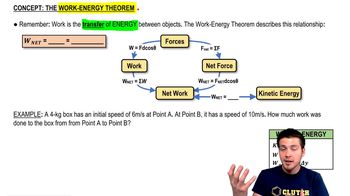
Work-Energy Principle

The Work-Energy Principle states that the work done on an object is equal to the change in its kinetic energy. In this scenario, the work done by the tension in the rope will contribute to increasing Paul's kinetic energy as he is pulled across the mat. Understanding this principle allows us to relate the forces acting on Paul to his resulting speed.
Recommended video:
Guided course
04:10
The Work-Energy Theorem

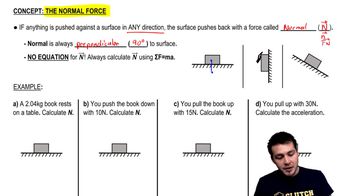
Friction and Normal Force

Friction is a force that opposes motion between two surfaces in contact. The coefficient of friction quantifies this resistance. In this case, the normal force acting on Paul, which is affected by the weight of the baby and the angle of the rope, will determine the frictional force opposing his motion. Calculating the net force requires understanding how these forces interact.
Recommended video:
Guided course
08:17
The Normal Force

Tension in a Rope

Tension is the force transmitted through a rope or string when it is pulled tight by forces acting from opposite ends. In this problem, the tension of 30 N at an angle of 30° affects both the horizontal and vertical components of the force acting on Paul. Analyzing the components of tension is crucial for determining the net force and subsequently the acceleration of Paul.
Recommended video:
Guided course
06:34
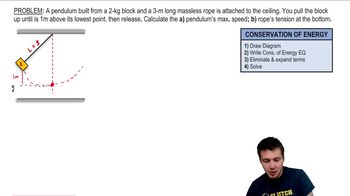
Calculating Tension in a Pendulum with Energy Conservation