
A 50 kg ice skater is gliding along the ice, heading due north at 4.0 m/s. The ice has a small coefficient of static friction, to prevent the skater from slipping sideways, but μk = 0. Suddenly, a wind from the northeast exerts a force of 4.0 N on the skater. What is the minimum value of μs that allows her to continue moving straight north?
A pile driver lifts a 250 kg weight and then lets it fall onto the end of a steel pipe that needs to be driven into the ground. A fall from an initial height of 1.5 m drives the pipe in 35 cm. What is the average force that the weight exerts on the pipe?
Verified step by step guidance
Verified video answer for a similar problem:
Key Concepts
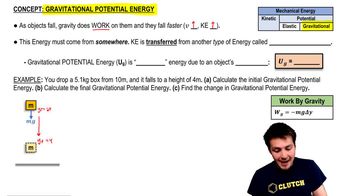
Gravitational Potential Energy
Kinetic Energy and Impact Force
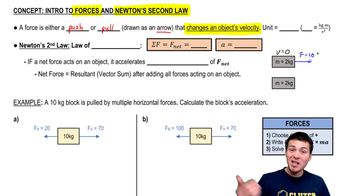
Newton's Second Law of Motion
Doug uses a 25 N horizontal force to push a 5.0 kg crate up a 2.0-m-high, 20° frictionless slope. What is the speed of the crate at the top of the slope?
A ball shot straight up with kinetic energy K₀ reaches height h. What height will it reach if the initial kinetic energy is doubled?
A 150 g particle at x = 0 is moving at 2.00 m/s in the + x - direction. As it moves, it experiences a force given by Fₓ = (0.250 N) sin (x/2.00 m). What is the particle's speed when it reaches x = 3.14 m?
Susan's 10 kg baby brother Paul sits on a mat. Susan pulls the mat across the floor using a rope that is angled 30° above the floor. The tension is a constant 30 N and the coefficient of friction is 0.20. Use work and energy to find Paul's speed after being pulled 3.0 m.
A 50 kg ice skater is gliding along the ice, heading due north at 4.0 m/s. The ice has a small coefficient of static friction, to prevent the skater from slipping sideways, but μk = 0. Suddenly, a wind from the northeast exerts a force of 4.0 N on the skater. Use work and energy to find the skater's speed after gliding 100 m in this wind.
