Ch 09: Work and Kinetic Energy
Knight Calc - Physics for Scientists and Engineers 5th Edition
Knight Calc5th EditionPhysics for Scientists and EngineersISBN: 9780137344796Not the one you use?Change textbook
Chapter 9, Problem 49b

A 50 kg ice skater is gliding along the ice, heading due north at 4.0 m/s. The ice has a small coefficient of static friction, to prevent the skater from slipping sideways, but μk = 0. Suddenly, a wind from the northeast exerts a force of 4.0 N on the skater. What is the minimum value of μs that allows her to continue moving straight north?

Verified step by step guidance
1
Step 1: Identify the forces acting on the skater. The skater is moving due north, and a wind from the northeast exerts a force of 4.0 N. The ice provides a static friction force to counteract the sideways component of the wind force. Since μk = 0, the kinetic friction is negligible, and only static friction is relevant.
Step 2: Break the wind force into components. The wind is coming from the northeast, which means it has both an eastward and northward component. Use trigonometry to find the components of the wind force: \( F_{east} = F \cdot \cos(45^\circ) \) and \( F_{north} = F \cdot \sin(45^\circ) \), where \( F = 4.0 \, \text{N} \).
Step 3: Determine the role of static friction. The static friction force must counteract the eastward component of the wind force to prevent the skater from slipping sideways. The maximum static friction force is given by \( F_{friction} = \mu_s \cdot F_{normal} \), where \( F_{normal} \) is the normal force exerted by the ice. For the skater, \( F_{normal} = m \cdot g \), where \( m = 50 \, \text{kg} \) and \( g = 9.8 \, \text{m/s}^2 \).
Step 4: Set up the inequality for static friction. To ensure the skater continues moving straight north, the static friction force must be at least equal to the eastward component of the wind force: \( \mu_s \cdot F_{normal} \geq F_{east} \). Substitute \( F_{normal} = m \cdot g \) and \( F_{east} = F \cdot \cos(45^\circ) \) into the inequality.
Step 5: Solve for \( \mu_s \). Rearrange the inequality to isolate \( \mu_s \): \( \mu_s \geq \frac{F \cdot \cos(45^\circ)}{m \cdot g} \). Substitute the known values for \( F \), \( m \), and \( g \) to find the minimum value of \( \mu_s \).

Verified video answer for a similar problem:

This video solution was recommended by our tutors as helpful for the problem above.
Was this helpful?

Key Concepts

Here are the essential concepts you must grasp in order to answer the question correctly.

Friction

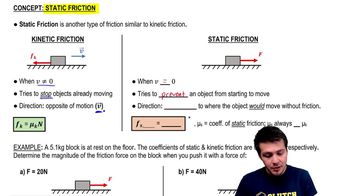
Friction is the force that opposes the relative motion of two surfaces in contact. It is characterized by two coefficients: static friction (μs), which prevents motion, and kinetic friction (μk), which acts when surfaces are sliding against each other. In this scenario, static friction is crucial as it must be sufficient to counteract the lateral force exerted by the wind, allowing the skater to maintain a straight path.
Recommended video:
Guided course
08:11
Static Friction & Equilibrium

Force and Motion

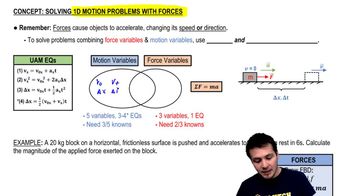
Newton's laws of motion describe the relationship between the forces acting on an object and its motion. The first law states that an object at rest or in uniform motion will remain so unless acted upon by a net external force. In this case, the wind exerts a force that could change the skater's direction, necessitating a balance of forces to keep her moving straight north.
Recommended video:
Guided course
05:29
Solving Motion Problems with Forces

Equilibrium

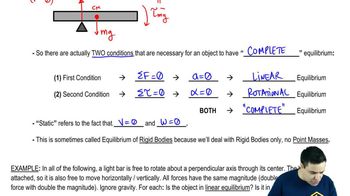
Equilibrium occurs when the net force acting on an object is zero, resulting in no change in motion. For the skater to continue moving straight north despite the wind's force, the static friction must equal the wind's force. This balance ensures that the skater does not slip sideways, highlighting the importance of calculating the minimum static friction coefficient required for equilibrium.
Recommended video:
Guided course
10:13
Torque & Equilibrium
Related Practice
Textbook Question

A ball shot straight up with kinetic energy K₀ reaches height h. What height will it reach if the initial kinetic energy is doubled?

Textbook Question

A pile driver lifts a 250 kg weight and then lets it fall onto the end of a steel pipe that needs to be driven into the ground. A fall from an initial height of 1.5 m drives the pipe in 35 cm. What is the average force that the weight exerts on the pipe?

1
views
Textbook Question

The gravitational attraction between two objects with masses mA and mB, separated by distance 𝓍, is F = GmAmB/𝓍², where G is the gravitational constant. If one mass is much greater than the other, the larger mass stays essentially at rest while the smaller mass moves toward it. Suppose a 1.5 x 10¹³ kg comet is passing the orbit of Mars, heading straight for the sun at a speed of 3.5 x 10⁴ m/s. What will its speed be when it crosses the orbit of Mercury? Astronomical data are given in the tables at the back of the book, and G = 6.67 x 10⁻¹¹ Nm²/kg².

1
views
Textbook Question

A red ball has a mass of 250 g. A constant force pushes the red ball horizontally and launches it at a speed of 15 m/s. The same force pushes a green ball through the same distance, launching it at 25 m/s. What is the mass of the green ball?

1
views
Textbook Question

A 50 kg ice skater is gliding along the ice, heading due north at 4.0 m/s. The ice has a small coefficient of static friction, to prevent the skater from slipping sideways, but μk = 0. Suddenly, a wind from the northeast exerts a force of 4.0 N on the skater. Use work and energy to find the skater's speed after gliding 100 m in this wind.

Textbook Question

A 737-800 jet airliner has twin engines, each with 105 kN thrust. A 78,000 kg jet reaches a takeoff speed of 70 m/s in a distance of 1100 m. What is the increase in thermal energy due to rolling friction and air drag?