Ch 09: Work and Kinetic Energy
Knight Calc - Physics for Scientists and Engineers 5th Edition
Knight Calc5th EditionPhysics for Scientists and EngineersISBN: 9780137344796Not the one you use?Change textbook
Chapter 9, Problem 42a

The energy used to pump liquids and gases through pipes is a significant fraction of the total energy consumption in the United States. Consider a small volume V of a liquid that has density ρ. Assume that the fluid is nonviscous so that friction with the pipe walls can be neglected. An upward-pushing force from a pump lifts this volume of fluid a height h at constant speed. How much work does the pump do?

Verified step by step guidance
1
Step 1: Begin by identifying the physical quantities involved in the problem. The volume of the liquid is V, its density is denoted as p (ρ), the height it is lifted is h, and the work done by the pump is what we need to calculate.
Step 2: Recall the formula for work done by a force: \( W = F \cdot d \cdot \cos(\theta) \). In this case, the force is acting vertically upward, and the displacement is also vertical, so \( \cos(\theta) = 1 \). Thus, \( W = F \cdot h \).
Step 3: Determine the force required to lift the liquid. The force is equal to the weight of the liquid, which is given by \( F = m \cdot g \), where \( m \) is the mass of the liquid and \( g \) is the acceleration due to gravity.
Step 4: Relate the mass of the liquid to its density and volume. The mass \( m \) can be expressed as \( m = \rho \cdot V \), where \( \rho \) is the density and \( V \) is the volume. Substituting this into the force equation gives \( F = \rho \cdot V \cdot g \).
Step 5: Substitute the expression for force into the work formula. The work done by the pump is \( W = F \cdot h \), so \( W = \rho \cdot V \cdot g \cdot h \). This is the amount of work required to lift the liquid a height \( h \) at constant speed.

Verified video answer for a similar problem:

This video solution was recommended by our tutors as helpful for the problem above.
Video duration:
5m
Was this helpful?

Key Concepts

Here are the essential concepts you must grasp in order to answer the question correctly.

Work

In physics, work is defined as the product of the force applied to an object and the distance over which that force is applied, in the direction of the force. Mathematically, it is expressed as W = F × d, where W is work, F is force, and d is distance. In the context of the question, the work done by the pump is the force exerted to lift the fluid multiplied by the height it is lifted.
Recommended video:
Guided course
06:58
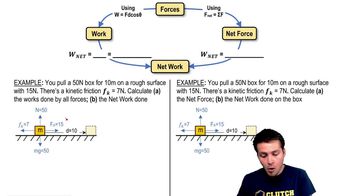
Calculating Net Work

Density

Density is a measure of mass per unit volume of a substance, typically expressed in kilograms per cubic meter (kg/m³). It is a crucial factor in determining the weight of the fluid being pumped, as the weight can be calculated using the formula weight = density × volume × gravitational acceleration. Understanding density helps in calculating the force required to lift the fluid.
Recommended video:
Guided course
8:13
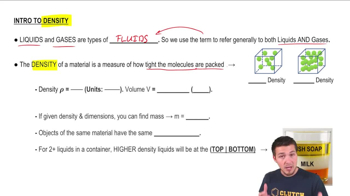
Intro to Density

Nonviscous Fluid

A nonviscous fluid is an idealized fluid that has no internal friction or viscosity, meaning it flows without resistance. This assumption simplifies calculations in fluid dynamics, as it allows us to neglect energy losses due to friction with the pipe walls. In the given scenario, treating the fluid as nonviscous means that the only work done by the pump is against the gravitational force acting on the fluid.
Recommended video:
Guided course
03:41
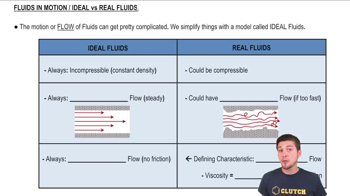
Ideal vs Real Fluids