
Ch.4 - The Study of Chemical Reactions
Wade - Organic Chemistry 9th Edition
Wade9th EditionOrganic ChemistryISBN: 9780135213728Not the one you use?Change textbook
Chapter 4, Problem 28

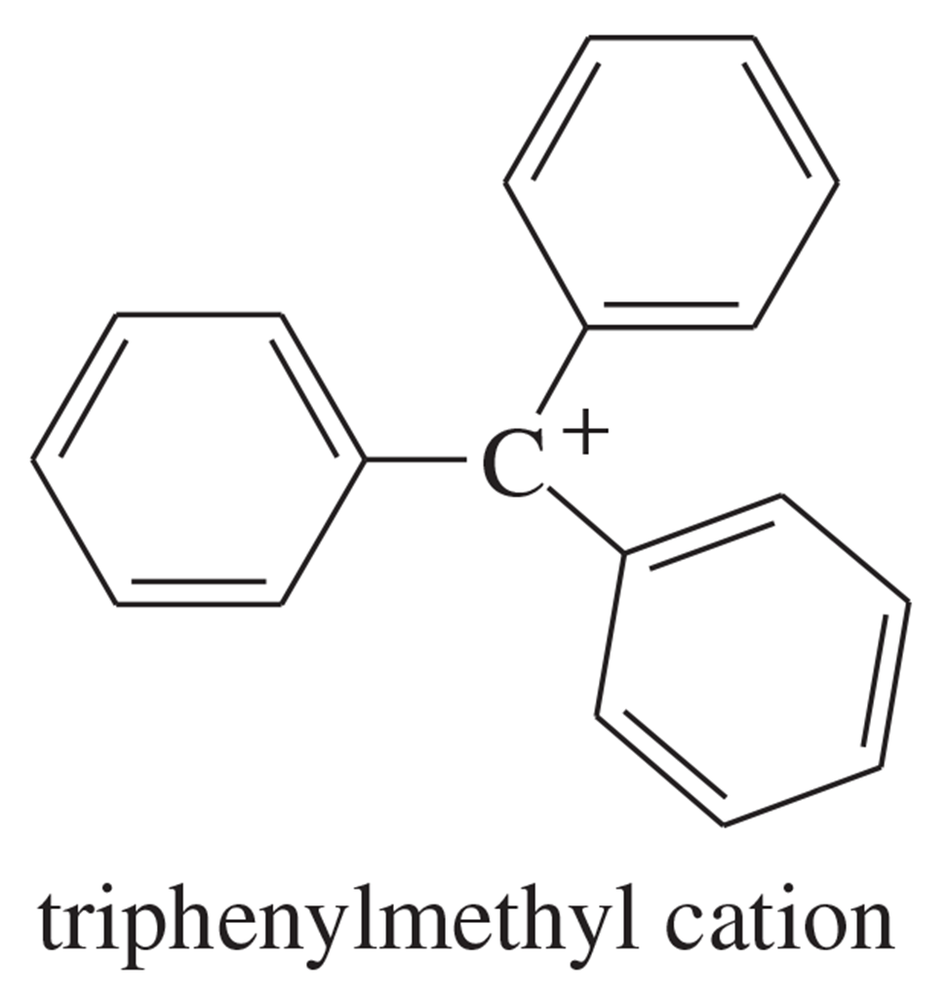
The triphenylmethyl cation is so stable that some of its salts can be stored for months. Explain why this cation is so stable.

Verified step by step guidance
1
The triphenylmethyl cation is stabilized by resonance. Resonance occurs when the positive charge on the central carbon atom can be delocalized across the three phenyl rings attached to it.
Each phenyl ring has a conjugated π-electron system, which allows the positive charge to be distributed over multiple atoms, reducing the overall energy of the cation.
The delocalization of the positive charge creates multiple resonance structures, which increases the stability of the molecule. This is a key feature of aromatic systems and conjugated π-electron systems.
Additionally, the phenyl rings are planar and aromatic, which further contributes to the stability of the cation through aromatic stabilization.
The combination of resonance stabilization and aromaticity makes the triphenylmethyl cation exceptionally stable, allowing its salts to be stored for extended periods.

Verified video answer for a similar problem:

This video solution was recommended by our tutors as helpful for the problem above.
Video duration:
4m
Was this helpful?

Key Concepts

Here are the essential concepts you must grasp in order to answer the question correctly.

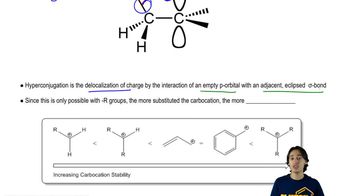
Carbocation Stability

Carbocations are positively charged species that are classified based on their stability. Stability increases with the degree of alkyl substitution, as more alkyl groups can donate electron density through hyperconjugation and inductive effects. The triphenylmethyl cation is exceptionally stable due to resonance stabilization, where the positive charge is delocalized over multiple carbon atoms.
Recommended video:
Guided course
05:58
Determining Carbocation Stability

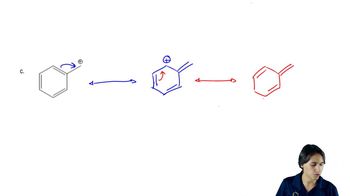
Resonance

Resonance is a concept in organic chemistry where a molecule can be represented by two or more valid Lewis structures, known as resonance structures. In the case of the triphenylmethyl cation, the positive charge can be delocalized across the aromatic rings, allowing for multiple resonance forms. This delocalization lowers the energy of the cation, contributing to its overall stability.
Recommended video:
Guided course
03:04
Drawing Resonance Structures

Aromaticity

Aromaticity refers to the enhanced stability of cyclic compounds with conjugated pi electron systems that follow Hückel's rule (4n + 2 pi electrons). The tropylium ion, a related structure, is aromatic and contributes to the stability of the triphenylmethyl cation. The presence of aromatic rings in the structure allows for effective electron delocalization, further stabilizing the cation.
Recommended video:
Guided course
08:19
Intro to Aromaticity