
Ch.4 - The Study of Chemical Reactions
Wade - Organic Chemistry 9th Edition
Wade9th EditionOrganic ChemistryISBN: 9780135213728Not the one you use?Change textbook
Chapter 4, Problem 25a

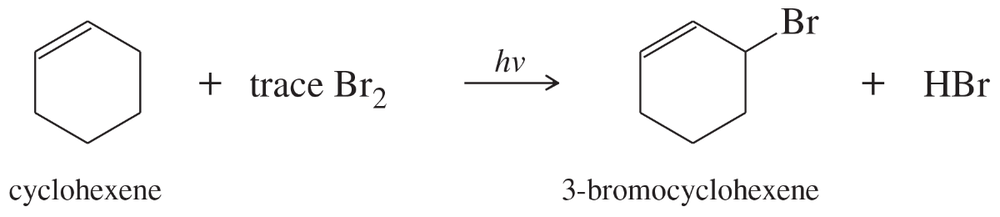
In the presence of a small amount of bromine, cyclohexene undergoes the following light-promoted reaction:

a. Propose a mechanism for this reaction.

Verified step by step guidance
1
Step 1: The reaction begins with the homolytic cleavage of the bromine molecule (Br₂) under the influence of light (hv). This generates two bromine radicals (Br•). The light energy provides the necessary activation for this bond cleavage.
Step 2: One of the bromine radicals abstracts a hydrogen atom from cyclohexene, forming HBr and leaving behind a cyclohexenyl radical. This step is a radical propagation step where the bromine radical initiates the formation of the reactive intermediate.
Step 3: The cyclohexenyl radical reacts with another bromine molecule (Br₂). The radical attacks one of the bromine atoms, forming a new C-Br bond and generating another bromine radical. This step propagates the radical chain reaction.
Step 4: The product formed is 3-bromocyclohexene, where the bromine atom is attached to the allylic position of the cyclohexene ring. The allylic position is favored due to the stability of the allylic radical intermediate formed during the reaction.
Step 5: The reaction terminates when two bromine radicals combine to form a bromine molecule (Br₂), or when other termination steps occur that neutralize the radicals. This ensures the reaction does not continue indefinitely.

Verified video answer for a similar problem:

This video solution was recommended by our tutors as helpful for the problem above.
Video duration:
7m
Was this helpful?

Key Concepts

Here are the essential concepts you must grasp in order to answer the question correctly.

Electrophilic Addition Reactions

Electrophilic addition reactions involve the addition of an electrophile to a nucleophile, typically across a double bond. In the case of cyclohexene, the double bond acts as a nucleophile, reacting with bromine (Br2) as the electrophile. This reaction leads to the formation of a brominated product, where the bromine atom adds to the carbon atoms of the double bond.
Recommended video:
Guided course
05:39
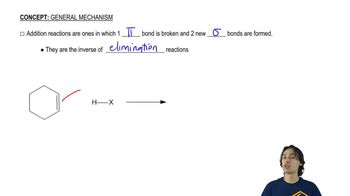
Features of Addition Mechanisms.

Radical Mechanism

The reaction of cyclohexene with bromine in the presence of light (hv) suggests a radical mechanism. This involves the homolytic cleavage of the Br-Br bond, generating bromine radicals. These radicals can then add to the double bond of cyclohexene, forming a radical intermediate that subsequently leads to the final brominated product through further radical reactions.
Recommended video:
Guided course
03:28
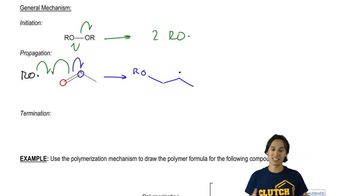
The mechanism of Radical Polymerization.

Stereochemistry of Addition

Stereochemistry plays a crucial role in electrophilic addition reactions, as the orientation of the added groups can affect the product's configuration. In the case of 3-bromocyclohexene, the addition of bromine can lead to different stereoisomers depending on the approach of the bromine radical to the double bond. Understanding the stereochemical outcomes is essential for predicting the properties and reactivity of the resulting compounds.
Recommended video:
1:38
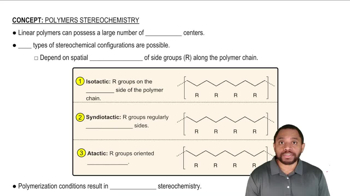
Polymer Stereochemistry Concept 1