
Ch.4 - The Study of Chemical Reactions
Wade - Organic Chemistry 9th Edition
Wade9th EditionOrganic ChemistryISBN: 9780135213728Not the one you use?Change textbook
Chapter 4, Problem 22c

Use the information in Table 4-2 to explain why toluene (PhCH3) has a very high octane rating of 111. Write an equation to show how toluene reacts with an alkyl free radical to give a relatively stable radical.

Verified step by step guidance
1
Step 1: Analyze the bond dissociation energy data provided in the tables. Toluene (PhCH3) contains a benzylic C-H bond, which has a bond dissociation energy of 376 kJ/mol. This is significantly lower than other types of C-H bonds, such as primary (423 kJ/mol), secondary (413 kJ/mol), and tertiary (403 kJ/mol). The lower bond dissociation energy indicates that the benzylic hydrogen is easier to remove, forming a benzylic radical.
Step 2: Explain the stability of the benzylic radical. The benzylic radical formed after homolytic cleavage of the C-H bond is stabilized by resonance. The unpaired electron on the benzylic carbon can delocalize into the aromatic ring, creating multiple resonance structures. This delocalization significantly increases the stability of the radical compared to radicals formed from other types of C-H bonds.
Step 3: Relate the stability of the benzylic radical to the high octane rating of toluene. The high stability of the benzylic radical means that toluene can resist premature combustion in an engine, which is a desirable property for high-octane fuels. The ability to form stable intermediates during combustion contributes to its high octane rating of 111.
Step 4: Write the equation for the reaction of toluene with an alkyl free radical. The alkyl free radical (R•) can abstract a hydrogen atom from the benzylic position of toluene, forming a benzylic radical (PhCH2•) and an alkane (RH). The equation is: PhCH3 + R• → PhCH2• + RH.
Step 5: Highlight the importance of resonance stabilization in organic reactions. The resonance stabilization of the benzylic radical is a key concept in organic chemistry, as it explains why certain reactions occur more readily and why certain intermediates are more stable. This principle is widely applicable in understanding reaction mechanisms and designing synthetic pathways.

Verified video answer for a similar problem:

This video solution was recommended by our tutors as helpful for the problem above.
Video duration:
5m
Was this helpful?

Key Concepts

Here are the essential concepts you must grasp in order to answer the question correctly.

Octane Rating

The octane rating is a measure of a fuel's ability to resist knocking during combustion. A higher octane rating indicates better performance in high-compression engines, as it signifies that the fuel can withstand greater pressure before igniting. Toluene's high octane rating of 111 suggests it has excellent anti-knock properties, making it a desirable component in gasoline.
Recommended video:
5:07
Rates of Intramolecular Reactions Concept 2

Free Radical Reactions

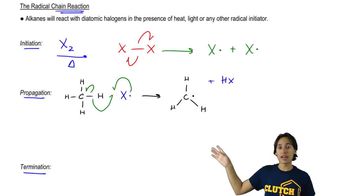
Free radical reactions involve species with unpaired electrons, which are highly reactive. In the context of toluene, when it reacts with an alkyl free radical, it can form a new radical through a process called hydrogen abstraction. This reaction is significant because it leads to the formation of a relatively stable radical, which can further participate in chemical reactions without decomposing immediately.
Recommended video:
Guided course
12:11
Radical Chain Reaction Mechanism.

Stability of Radicals

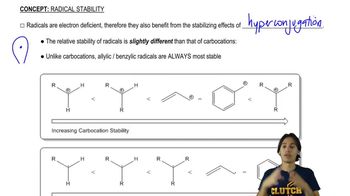
The stability of free radicals is influenced by their structure and the surrounding substituents. Toluene, with its aromatic ring, stabilizes the radical formed after hydrogen abstraction due to resonance. This delocalization of the unpaired electron over the aromatic system reduces the energy of the radical, making it more stable compared to aliphatic radicals, which are less stabilized.
Recommended video:
Guided course
03:43
The radical stability trend.