
Ch.4 - The Study of Chemical Reactions
Wade - Organic Chemistry 9th Edition
Wade9th EditionOrganic ChemistryISBN: 9780135213728Not the one you use?Change textbook
Chapter 4, Problem 22b

Alkoxy radicals (R—O•) are generally more stable than alkyl (R•) radicals. Write an equation showing an alkyl free radical (from burning gasoline) abstracting a ­hydrogen atom from tert-butyl alcohol, (CH3)3COH. Explain why tert-butyl alcohol works as an antiknock additive for gasoline

Verified step by step guidance
1
Write the chemical equation for the reaction: An alkyl radical (R•) abstracts a hydrogen atom from tert-butyl alcohol ((CH₃)₃COH). The reaction can be represented as: R• + (CH₃)₃COH → RH + (CH₃)₃CO•. Here, the alkyl radical (R•) reacts with tert-butyl alcohol, resulting in the formation of an alkane (RH) and a tert-butoxy radical ((CH₃)₃CO•).
Explain the stability of the tert-butoxy radical ((CH₃)₃CO•): The alkoxy radical is stabilized by resonance and the electron-donating inductive effects of the three methyl groups attached to the central carbon. This makes the tert-butoxy radical more stable than the alkyl radical (R•).
Discuss the role of tert-butyl alcohol as an antiknock additive: In gasoline combustion, knocking occurs due to uncontrolled chain reactions involving free radicals. Tert-butyl alcohol acts as a radical scavenger by donating a hydrogen atom to alkyl radicals, forming a more stable alkoxy radical ((CH₃)₃CO•). This interrupts the chain reaction and reduces knocking.
Highlight the importance of hydrogen abstraction: The ability of tert-butyl alcohol to donate a hydrogen atom to alkyl radicals is key to its function as an antiknock additive. The resulting tert-butoxy radical is less reactive and does not propagate the chain reaction, thereby stabilizing the combustion process.
Summarize the benefits of tert-butyl alcohol in gasoline: By reducing knocking, tert-butyl alcohol improves engine performance and efficiency. Its ability to stabilize free radicals makes it an effective additive for smoother combustion.

Verified video answer for a similar problem:

This video solution was recommended by our tutors as helpful for the problem above.
Video duration:
4m
Was this helpful?

Key Concepts

Here are the essential concepts you must grasp in order to answer the question correctly.

Radical Stability

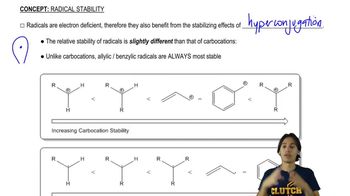
Radical stability refers to the relative stability of free radicals, which are species with unpaired electrons. Alkoxy radicals (R—O•) are generally more stable than alkyl radicals (R•) due to the presence of the electronegative oxygen atom, which can delocalize the unpaired electron through resonance. This stabilization makes alkoxy radicals less reactive compared to their alkyl counterparts, influencing their behavior in chemical reactions.
Recommended video:
Guided course
03:43
The radical stability trend.

Hydrogen Abstraction

Hydrogen abstraction is a fundamental reaction mechanism in organic chemistry where a radical species removes a hydrogen atom from a molecule, resulting in the formation of a new radical and a stable molecule. In the context of the question, an alkyl radical from burning gasoline abstracts a hydrogen atom from tert-butyl alcohol, leading to the generation of a new radical and a more stable product. This process is crucial in combustion and radical chain reactions.
Recommended video:
Guided course
00:48
The definition of hydrogenation.

Antiknock Agents

Antiknock agents are additives used in gasoline to prevent engine knocking, which is the premature ignition of the fuel-air mixture in an engine cylinder. Tert-butyl alcohol acts as an antiknock additive because its structure allows for better combustion characteristics and reduces the formation of harmful radicals during combustion. This leads to smoother engine operation and improved performance by enhancing the octane rating of the fuel.
Recommended video:
Guided course
09:28
Reducing Agents