Ch.4 - The Study of Chemical Reactions
Wade - Organic Chemistry 9th Edition
Wade9th EditionOrganic ChemistryISBN: 9780135213728Not the one you use?Change textbook
Chapter 4, Problem 25b,c

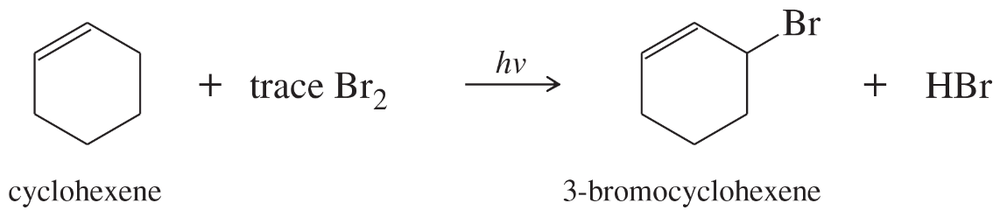
In the presence of a small amount of bromine, cyclohexene undergoes the following light-promoted reaction:

b. Draw the structure of the rate-limiting transition state.
c. Use Hammond's postulate to predict which intermediate most closely resembles this transition state.

Verified step by step guidance
1
Step 1: Understand the reaction mechanism. The reaction involves the addition of bromine to cyclohexene under light (hv), which promotes a radical chain reaction. The first step is the homolytic cleavage of Br2 to form two bromine radicals (Br•). These radicals initiate the reaction by abstracting a hydrogen atom from cyclohexene, forming a cyclohexenyl radical.
Step 2: Identify the rate-limiting step. In radical chain reactions, the rate-limiting step is typically the step that forms the most stable intermediate. Here, the rate-limiting step is the formation of the cyclohexenyl radical, which occurs when a bromine radical abstracts a hydrogen atom from cyclohexene.
Step 3: Draw the structure of the rate-limiting transition state. The transition state for the hydrogen abstraction step will involve partial bond breaking of the C-H bond in cyclohexene and partial bond formation between the hydrogen atom and the bromine radical. Represent this structure with dashed lines to indicate the bonds in the process of breaking and forming.
Step 4: Apply Hammond's postulate. Hammond's postulate states that the structure of the transition state resembles the structure of the species (reactants or products) to which it is closer in energy. Since the formation of the cyclohexenyl radical is endothermic, the transition state will more closely resemble the cyclohexenyl radical intermediate than the starting materials.
Step 5: Conclude the analysis. Based on Hammond's postulate, the transition state most closely resembles the cyclohexenyl radical intermediate. This is because the energy of the transition state is closer to the energy of the intermediate than to the energy of the reactants.

Verified video answer for a similar problem:

This video solution was recommended by our tutors as helpful for the problem above.
Video duration:
7m
Was this helpful?

Key Concepts

Here are the essential concepts you must grasp in order to answer the question correctly.

Rate-Limiting Transition State

The rate-limiting transition state is the highest energy state along the reaction pathway, representing a critical point where bonds are partially broken and formed. It determines the overall rate of the reaction, as the energy required to reach this state is the largest barrier. Understanding this concept is essential for predicting reaction mechanisms and the stability of intermediates.
Recommended video:

Hammond's Postulate

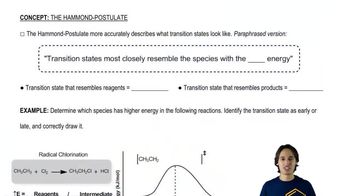
Hammond's postulate states that the structure of the transition state resembles the structure of the closest stable species (intermediate) in energy. If the transition state is closer in energy to the reactants, it will resemble them more, and if it is closer to the products, it will resemble the products. This concept helps in predicting the characteristics of the transition state based on the stability of intermediates.
Recommended video:
Guided course
01:30
Defining the Hammond Postulate.

Bromination of Alkenes

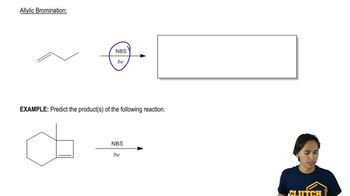
Bromination of alkenes involves the addition of bromine across the double bond, typically resulting in the formation of vicinal dibromides. In the case of cyclohexene, the reaction proceeds via a radical mechanism when light is present, leading to the formation of brominated products. Understanding the mechanism of bromination is crucial for predicting the products and the nature of the transition state.
Recommended video:
Guided course
00:54
Mechanism of Allylic Bromination.