
Ch.4 - The Study of Chemical Reactions
Wade - Organic Chemistry 9th Edition
Wade9th EditionOrganic ChemistryISBN: 9780135213728Not the one you use?Change textbook
Chapter 4, Problem 32

Acetonitrile (CH3C≡N) is deprotonated by very strong bases. Write resonance forms to show the stabilization of the carbanion that results.

Verified step by step guidance
1
Identify the acidic hydrogen in acetonitrile (CH3C≡N). The hydrogen attached to the carbon adjacent to the nitrile group is the most acidic.
When a strong base deprotonates acetonitrile, it removes this acidic hydrogen, resulting in a carbanion at the carbon adjacent to the nitrile group.
Draw the structure of the carbanion: CH2=C≡N⁻. The negative charge is on the carbon that was deprotonated.
To show resonance stabilization, move the lone pair of electrons from the carbanion to form a double bond with the carbon of the nitrile group, resulting in a new resonance structure.
The new resonance structure will have a double bond between the two carbons (CH2=C=N⁻) and the negative charge will be on the nitrogen atom, showing the delocalization of the negative charge.

Verified video answer for a similar problem:

This video solution was recommended by our tutors as helpful for the problem above.
Video duration:
5m
Was this helpful?

Key Concepts

Here are the essential concepts you must grasp in order to answer the question correctly.

Resonance

Resonance in organic chemistry refers to the delocalization of electrons across adjacent atoms in a molecule, which can be represented by multiple valid Lewis structures. These structures, known as resonance forms, depict the same molecule but with different arrangements of electrons, helping to illustrate the stability provided by electron delocalization.
Recommended video:
Guided course
03:04
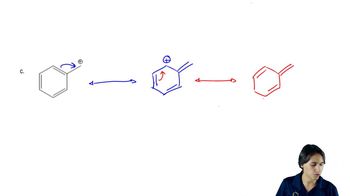
Drawing Resonance Structures

Carbanion

A carbanion is an anion in which carbon has an unshared pair of electrons and bears a negative charge. Carbanions are typically formed by the removal of a proton from a carbon atom, and their stability is influenced by factors such as resonance, inductive effects, and the hybridization of the carbon atom bearing the negative charge.
Recommended video:
2:36
Side-Chain Reactions of Substituted Pyridines Concept 1

Deprotonation

Deprotonation is the removal of a proton (H⁺) from a molecule, resulting in the formation of a conjugate base. In the context of acetonitrile, deprotonation by a strong base leads to the formation of a carbanion, which can be stabilized through resonance, as the negative charge can be delocalized over the molecule.
Recommended video:
4:30
Step-Growth Polymers: Epoxy Resin Example 1
Related Practice
Textbook Question

Consider the following reaction-energy diagram.

a. Label the reactants and the products. Label the activation energy for the first step and the second step.

b. Is the overall reaction endothermic or exothermic? What is the sign of ΔH°?

c. Which points in the curve correspond to intermediates? Which correspond to transition states?

d. Label the transition state of the rate-limiting step. Does its structure resemble the reactants, the products, or an ­intermediate?

1
views
Textbook Question

Rank the following radicals in decreasing order of stability. Classify each as primary, secondary, or tertiary.

a. The isopentyl radical,

b. The 3-methyl-2-butyl radical,

c. The 2-methyl-2-butyl radical,

d.

1
views
Textbook Question

The following reaction is a common synthesis used in the organic chemistry laboratory course.

When we double the concentration of methoxide ion (CH3O), we find that the reaction rate doubles. When we triple the concentration of 1-bromobutane, we find that the reaction rate triples.

a. What is the order of this reaction with respect to 1-bromobutane? What is the order with respect to methoxide ion? Write the rate equation for this reaction. What is the overall order?

1
views
Textbook Question

The triphenylmethyl cation is so stable that some of its salts can be stored for months. Explain why this cation is so stable.

2
views
Textbook Question

When it is strongly heated, ethyl diazoacetate decomposes to give nitrogen gas and a carbene. Draw a Lewis structure of the carbene.

2
views
Textbook Question

Acetylacetone (pentane-2,4-dione) reacts with sodium hydroxide to give water and the sodium salt of a carbanion. Write a complete structural formula for the carbanion, and use resonance forms to show the stabilization of the carbanion.

1
views