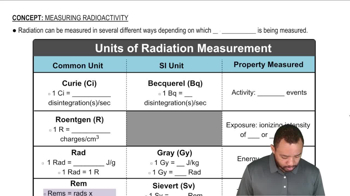
Harmful chemical spills can often be cleaned up by treatment with another chemical. For example, a spill of H₂SO₄ might be neutralized by addition of NaHCO₃. Why is it that the harmful radioactive wastes from nuclear power plants cannot be cleaned up as easily?
Verified step by step guidance
1
Understand the nature of the substances involved: H₂SO₄ is a strong acid, and NaHCO₃ is a base. When they react, they undergo a neutralization reaction, which is a chemical process that can be controlled and results in less harmful products.
Recognize the type of reaction: The reaction between H₂SO₄ and NaHCO₃ is a neutralization reaction, which typically results in the formation of water, carbon dioxide, and a salt (in this case, sodium sulfate). This is a straightforward chemical reaction.
Consider the nature of radioactive waste: Radioactive waste contains unstable isotopes that decay over time, releasing radiation. This is a nuclear process, not a chemical one, and involves changes in the nucleus of atoms rather than the rearrangement of electrons in chemical reactions.
Understand the challenges with radioactive waste: Unlike chemical reactions, nuclear reactions cannot be easily controlled or neutralized by adding another substance. The decay of radioactive materials is a process that occurs over long periods, and the waste remains hazardous until it has decayed to a safe level.
Explore the methods for dealing with radioactive waste: Instead of neutralization, radioactive waste management involves containment, storage, and isolation to prevent exposure to radiation, often requiring complex and long-term solutions.
Verified video answer for a similar problem:
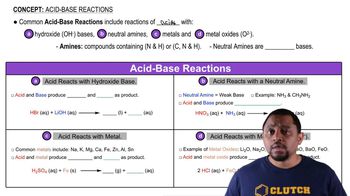
This video solution was recommended by our tutors as helpful for the problem above
Video duration:
4m
Play a video:
0 Comments
Key Concepts
Here are the essential concepts you must grasp in order to answer the question correctly.
Acid-Base Neutralization
Acid-base neutralization is a chemical reaction where an acid reacts with a base to produce water and a salt, effectively reducing the acidity or basicity of a solution. In the example given, sulfuric acid (H₂SO₄) is neutralized by sodium bicarbonate (NaHCO₃), resulting in less harmful products. This process is straightforward for many common acids and bases, allowing for effective cleanup.
Radioactive waste consists of materials that are radioactive and can remain hazardous for thousands of years. Unlike typical chemical spills, radioactive waste cannot be neutralized through simple chemical reactions. The isotopes present in radioactive waste decay over time, but their long half-lives and the nature of their radiation make them difficult to manage and require specialized containment and disposal methods.
Chemical stability refers to how likely a substance is to undergo a chemical reaction. Many radioactive materials are chemically stable and do not react easily with other substances, making them resistant to neutralization. This stability complicates cleanup efforts, as traditional chemical treatments that work for non-radioactive spills may not be effective for radioactive materials, necessitating more complex and controlled disposal methods.