What is wrong with the following decay curve? Explain.
Verified step by step guidance
1
Identify the type of decay process represented by the curve. Typically, decay processes are exponential, such as radioactive decay.
Examine the shape of the curve. In an exponential decay, the curve should decrease rapidly at first and then level off, approaching zero but never actually reaching it.
Check the y-axis values. The sample remaining should decrease by a consistent percentage over equal time intervals if it is exponential decay.
Observe the x-axis values. Ensure that the time intervals are consistent and that the decay rate is constant over these intervals.
Analyze the end behavior of the curve. In a proper decay curve, the sample should never reach zero, but this curve seems to approach a non-zero value, which might indicate an error in the representation of the decay process.
Verified video answer for a similar problem:
This video solution was recommended by our tutors as helpful for the problem above
Video duration:
2m
Play a video:
0 Comments
Key Concepts
Here are the essential concepts you must grasp in order to answer the question correctly.
Radioactive Decay
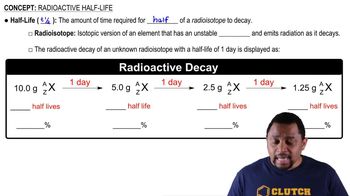
Radioactive decay is the process by which an unstable atomic nucleus loses energy by emitting radiation. This decay occurs at a predictable rate, characterized by the half-life, which is the time required for half of the radioactive sample to decay. Understanding this concept is crucial for interpreting decay curves, as they typically exhibit an exponential decrease in the amount of the sample over time.
Half-life is a specific time period in which half of a given amount of a radioactive substance will have decayed. This concept is fundamental in understanding decay curves, as they should show a consistent pattern of reduction at each half-life interval. If the curve deviates from this expected pattern, it may indicate an error in measurement or an incorrect assumption about the decay process.
An exponential decay curve represents the relationship between the remaining quantity of a substance and time, typically showing a rapid decrease initially that slows over time. In a correctly plotted decay curve, the graph should approach zero asymptotically but never actually reach it. Any irregularities in the curve, such as linear segments or unexpected plateaus, suggest inaccuracies in data collection or analysis.