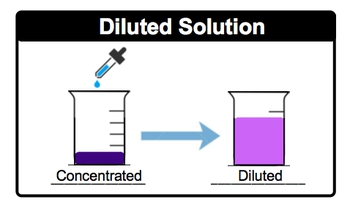
A stock solution is a concentrated solution that can be diluted for various laboratory applications. Dilution involves adding more solvent, typically water, to a solution to decrease its concentration. For instance, when a dark purple solution is gradually mixed with water, the color lightens to a fuchsia hue, indicating a reduction in concentration. This visual change exemplifies the dilution process, where the original solution becomes less concentrated as more solvent is introduced. Understanding this concept is crucial in laboratory settings, as it allows for the preparation of solutions with desired concentrations for experiments and analyses.
13. Solutions
Dilutions
13. Solutions
Dilutions: Videos & Practice Problems
Topic summary
Dilutions describe making a solution less concentrated by adding more solvent, usually water. A concentrated stock solution or standard solution becomes a lower-concentration solution, so the molarity decreases from an initial value to a final value. In this process, the amount of solute stays the same while the total volume increases, which is why the initial concentration is always greater than the diluted concentration.
The central relationship is \(M_1V_1 = M_2V_2\) . Here, molarity \(M_1\) and volume \(V_1\) are before dilution, and \(M_2\) and \(V_2\) are after dilution. The final volume is found from \(V_2 = V_1 + \text{volume of solvent added}\) . A common sign of a dilution problem is one compound being described with two different molarities or a stated final volume after water is added.
In Dilutions, a solvent (usually water) is added to a concentrated solution.
Concentrated & Diluted Solutions
0
Concept
Dilutions

Video duration:
1mDilutions Video Summary
Study Smarter with Worksheets.
Follow along with each video using our printable worksheets

0
Example
Dilutions Example 1
Video duration:
1mDilutions Example 1 Video Summary
To determine the concentration of solutions based on the number of solute moles represented by spheres, we can calculate the molarity for each solution. Molarity (M) is defined as the number of moles of solute divided by the volume of solution in liters:
Molarity (M) = \(\frac{\text{moles of solute}}{\text{liters of solution}}\)
In this example, we have three solutions:
Solution A: Contains 5 spheres (moles of solute) in 1 liter of solution. Thus, the molarity is:
M_A = \(\frac{5 \text{ moles}}{1 \text{ L}} = 5 \text{ M}\)
Solution B: Contains 3 spheres in 2 liters of solution. Therefore, the molarity is:
M_B = \(\frac{3 \text{ moles}}{2 \text{ L}} = 1.5 \text{ M}\)
Solution C: Contains 6 spheres in 3 liters of solution, giving us:
M_C = \(\frac{6 \text{ moles}}{3 \text{ L}} = 2 \text{ M}\)
Now, to arrange the solutions from least concentrated to most concentrated based on their molarity values, we find:
1. Solution B: 1.5 M
2. Solution C: 2 M
3. Solution A: 5 M
Thus, the order from least concentrated to most concentrated is B, C, and A.
0
Concept
Dilutions
Video duration:
58sDilutions Video Summary
Understanding dilution is essential in chemistry, as it allows us to create solutions with lower concentrations from more concentrated ones. The process of dilution can be quantitatively described using the equation:
\( M_1 V_1 = M_2 V_2 \)
In this equation, \( M_1 \) and \( V_1 \) represent the molarity and volume of the solution before dilution, while \( M_2 \) and \( V_2 \) represent the molarity and volume after dilution. It is important to note that \( M_1 \), the molarity of the concentrated solution, is always greater than \( M_2 \), the molarity of the diluted solution.
The final volume after dilution, \( V_2 \), is determined by the initial volume \( V_1 \) plus the volume of solvent added. This relationship can be expressed as:
\( V_2 = V_1 + V_{\text{solvent}} \)
By applying these principles, one can effectively prepare solutions with desired concentrations, which is a fundamental skill in various scientific applications.

0
Example
Dilutions Example 2
Video duration:
2mDilutions Example 2 Video Summary
To determine the volume of a concentrated solution needed to prepare a diluted solution, we can apply the dilution equation, which is expressed as:
\( M_1 V_1 = M_2 V_2 \)
In this equation, \( M_1 \) represents the molarity of the concentrated solution, \( V_1 \) is the volume of the concentrated solution we need to find, \( M_2 \) is the molarity of the diluted solution, and \( V_2 \) is the volume of the diluted solution.
In the given problem, we have:
- Concentrated solution: 5.2 M (this is \( M_1 \))
- Diluted solution: 2.7 M (this is \( M_2 \))
- Volume of diluted solution: 3.5 L (this is \( V_2 \))
Since we are dealing with one compound, hydrobromic acid, and two different molarities, this indicates a dilution scenario. To find \( V_1 \), we rearrange the equation:
\( V_1 = \frac{M_2 V_2}{M_1} \)
Substituting the known values into the equation gives:
\( V_1 = \frac{(2.7 \, \text{M})(3.5 \, \text{L})}{5.2 \, \text{M}} \)
Calculating this yields:
\( V_1 = \frac{9.45 \, \text{mol}}{5.2 \, \text{M}} = 1.8173 \, \text{L} \)
To convert liters to milliliters, we use the conversion factor where 1 L = 1000 mL:
\( 1.8173 \, \text{L} \times 1000 \, \text{mL/L} = 1817.3 \, \text{mL} \)
Considering significant figures, since the values 5.2, 3.5, and 2.7 all have two significant figures, we round 1817.3 mL to 1800 mL. Thus, the final answer is:
1800 mL
In summary, when faced with a dilution problem involving a single compound and two molarities, the dilution equation is the key to finding the unknown volume of the concentrated solution needed for preparation.
0
Problem
To what final volume would 100 mL of 5.0 M KCl have to be diluted in order to make a solution that is 0.54 M KCl?
A
72 mL
B
289 mL
C
330 mL
D
930 mL
E
1400 mL
0
Problem
If 880 mL of water is added to 125.0 mL of a 0.770 M HBrO4 solution what is the resulting molarity?
A
0.096 M
B
0.136 M
C
0.257 M
D
0.892 M
E
1.76 M
0
Problem
A student prepared a stock solution by dissolving 25.00 g of NaOH in enough water to make 150.0 mL solution. The student took 20.0 mL of the stock solution and diluted it with enough water to make 250.0 mL solution. Finally taking 75.0 mL of that solution and dissolving it in water to make 500 mL solution. What is the concentration of NaOH for this final solution? (MW of NaOH:40.00 g/mol).
A
0.0500 M
B
0.025 M
C
0.005 M
D
0.500 M
E
0.0100 M
Do you want more practice?
More setsGo over this topic definitions with flashcards
More setsHere's what students ask on this topic:
Dilution in chemistry refers to the process of making a solution less concentrated by adding more solvent, usually water. This means that the amount of solute remains the same, but the total volume of the solution increases, resulting in a lower concentration. For example, if you have a dark purple concentrated solution and add water, the color becomes lighter, indicating a decrease in concentration. Dilution is commonly used in laboratories to prepare solutions of desired concentrations from a more concentrated stock or standard solution.
To calculate the concentration after dilution, you use the dilution equation: . Here, and are the molarity and volume before dilution, while and are after dilution. Since dilution adds solvent, . This equation helps you find the new concentration after adding solvent.
A stock solution, also called a standard solution, is a concentrated solution prepared in advance and used as the starting point for dilutions. It contains a known concentration of solute and is often too concentrated for direct use in experiments. By diluting the stock solution with solvent, usually water, you can create solutions of lower concentration that are suitable for specific laboratory applications. Using stock solutions saves time and ensures accuracy because you only need to dilute to the desired concentration rather than preparing new solutions from scratch each time.
Multiple dilution steps involve diluting a solution several times in sequence. Each step uses the dilution equation to find the new concentration after adding solvent. The output concentration of one step becomes the input concentration for the next. This repeated application reduces the concentration progressively. It is important to keep track of volumes and concentrations at each step to accurately calculate the final concentration after all dilutions.
The molarity before dilution () is always greater than after dilution () because dilution involves adding solvent to increase the total volume without changing the amount of solute. Since molarity is defined as moles of solute per liter of solution, increasing the volume while keeping moles constant decreases the molarity. Therefore, the concentration decreases, making greater than .