Each of the following graphs is obtained from the graph of ƒ(x)=|x| or g(x)=√x by applying several of the transformations discussed in this section. Describe the transformations and give an equation for the graph.
Ch. 2 - Graphs and Functions

Chapter 3, Problem 97
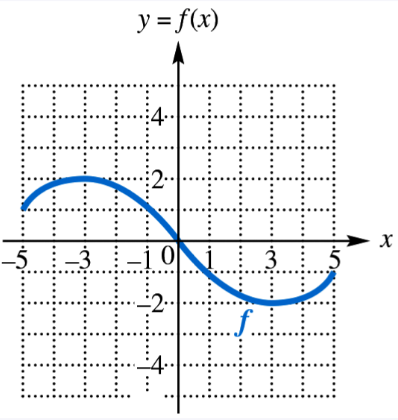
For each function graphed, give the minimum and maximum values of ƒ(x) and the x-values at which they occur.

Verified step by step guidance1
Step 1: Identify the maximum value of the function by locating the highest point on the graph. This is where the function reaches its peak.
Step 2: Note the y-coordinate of this highest point, which represents the maximum value of ƒ(x), and the corresponding x-coordinate where this maximum occurs.
Step 3: Identify the minimum value of the function by locating the lowest point on the graph. This is where the function reaches its lowest value.
Step 4: Note the y-coordinate of this lowest point, which represents the minimum value of ƒ(x), and the corresponding x-coordinate where this minimum occurs.
Step 5: Summarize the results by stating the minimum and maximum values of ƒ(x) along with their respective x-values.

Verified video answer for a similar problem:
This video solution was recommended by our tutors as helpful for the problem above.
Video duration:
3mWas this helpful?
Key Concepts
Here are the essential concepts you must grasp in order to answer the question correctly.
Maximum and Minimum Values of a Function
Maximum and minimum values of a function are the highest and lowest points on its graph, respectively. A maximum value is where the function reaches a peak, and a minimum value is where it reaches a trough. These values can be local (relative) or absolute (global) within a given domain.
Recommended video:
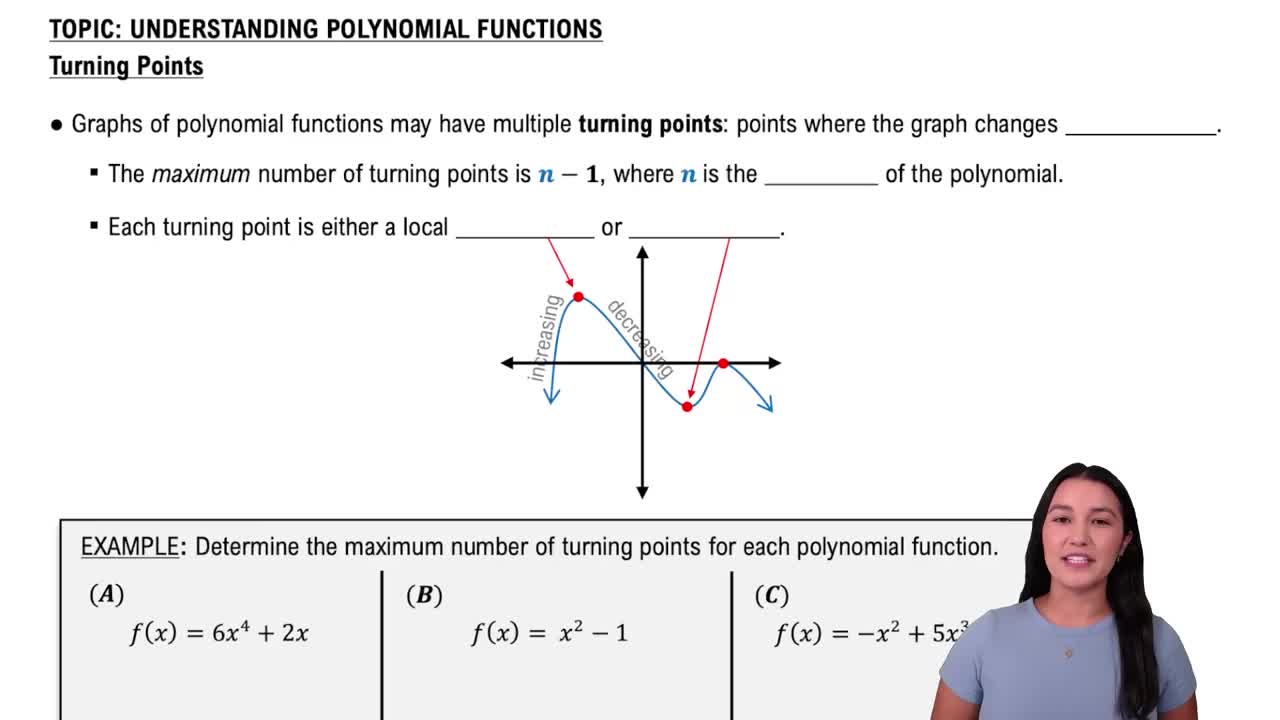
Maximum Turning Points of a Polynomial Function
Reading and Interpreting Graphs
Understanding how to read graphs involves identifying key points such as peaks, valleys, and intercepts. The x-values at these points correspond to where the function attains its maximum or minimum values. Accurate interpretation helps in extracting meaningful information about the function's behavior.
Recommended video:
Guided course
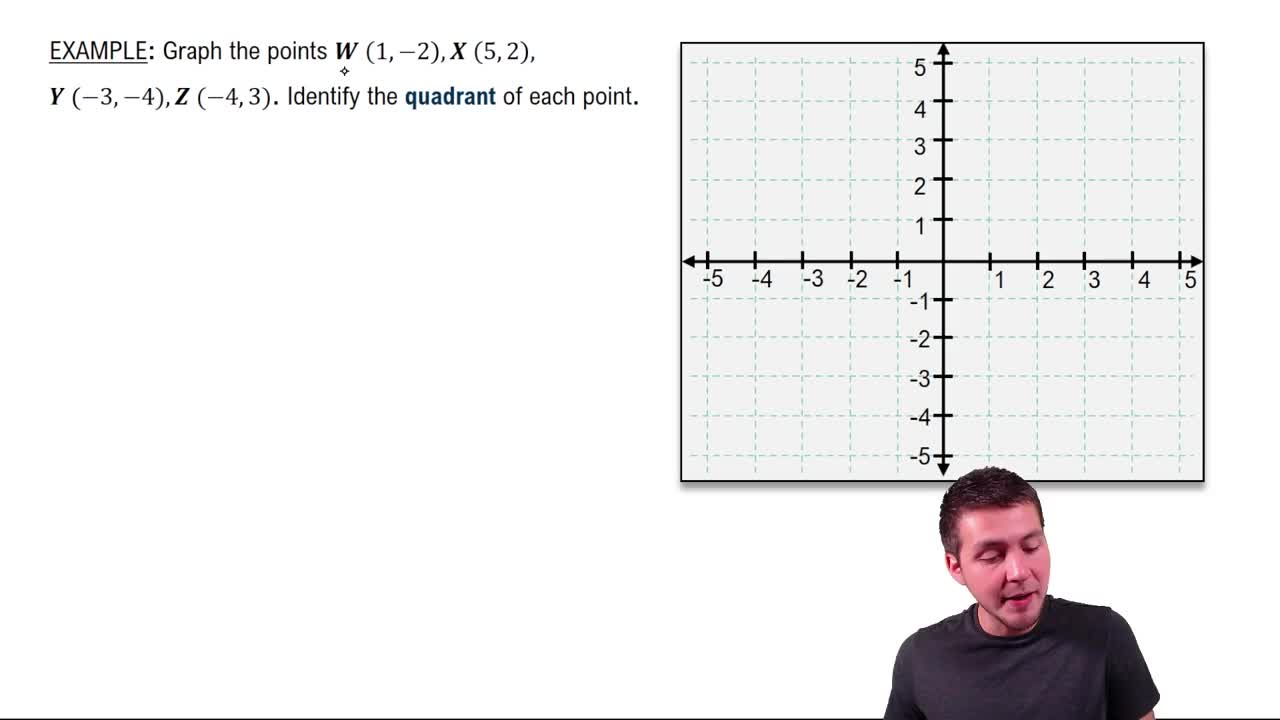
Graphs and Coordinates - Example
Function Notation and Evaluation
Function notation, written as ƒ(x), represents the output of a function for a given input x. Evaluating the function at specific x-values helps determine the corresponding y-values, which are essential for identifying minimum and maximum points on the graph.
Recommended video:
Evaluating Composed Functions
Related Practice
Textbook Question
Textbook Question
Describe how the graph of each function can be obtained from the graph of ƒ(x) = |x|. g(x) = -|x|
Textbook Question
Let ƒ(x) = 3x -4. Find an equation for each reflection of the graph of ƒ(x). across the y-axis
Textbook Question
For each function graphed, give the minimum and maximum values of ƒ(x) and the x-values at which they occur.
6
views
Textbook Question
Let ƒ(x) = 3x -4. Find an equation for each reflection of the graph of ƒ(x). across the x-axis
Textbook Question
Each of the following graphs is obtained from the graph of ƒ(x)=|x| or g(x)=√x by applying several of the transformations discussed in this section. Describe the transformations and give an equation for the graph.