Ch. 2 - Graphs and Functions
Lial - College Algebra 13th Edition
Lial13th EditionCollege AlgebraISBN: 9780136881063Not the one you use?Change textbook
Chapter 3, Problem 99

Let ƒ(x) = 3x -4. Find an equation for each reflection of the graph of ƒ(x). across the y-axis

Verified step by step guidance
1
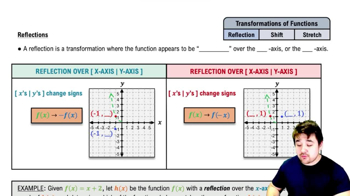
Recall that reflecting a graph across the y-axis means replacing every x-coordinate with its opposite, or -x. This changes the input of the function from x to -x.
Start with the original function: \(f(x) = 3x - 4\).
To find the reflection across the y-axis, substitute \(-x\) for \(x\) in the function: \(f(-x) = 3(-x) - 4\).
Simplify the expression: \(f(-x) = -3x - 4\).
The equation \(f(-x) = -3x - 4\) represents the reflection of the graph of \(f(x)\) across the y-axis.

Verified video answer for a similar problem:

This video solution was recommended by our tutors as helpful for the problem above.
Video duration:
1m
Was this helpful?

Key Concepts

Here are the essential concepts you must grasp in order to answer the question correctly.

Function Reflection Across the y-Axis

Reflecting a function across the y-axis involves replacing the input variable x with -x in the function's formula. This transformation flips the graph horizontally, so each point (x, y) moves to (-x, y). For example, if f(x) = 3x - 4, then its reflection is f(-x) = 3(-x) - 4.
Recommended video:
5:00
Reflections of Functions

Linear Functions and Their Graphs

A linear function has the form f(x) = mx + b, where m is the slope and b is the y-intercept. Its graph is a straight line. Understanding the slope and intercept helps visualize how transformations like reflections affect the line's position and orientation.
Recommended video:
5:26
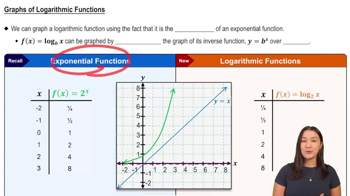
Graphs of Logarithmic Functions

Function Notation and Evaluation

Function notation f(x) represents the output value for an input x. Evaluating a function at a specific input means substituting that input into the formula. This concept is essential when applying transformations, such as replacing x with -x to find the reflected function.
Recommended video:
4:26
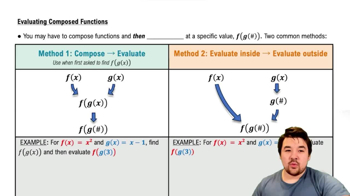
Evaluating Composed Functions