Ch. 2 - Graphs and Functions
Lial - College Algebra 13th Edition
Lial13th EditionCollege AlgebraISBN: 9780136881063Not the one you use?Change textbook
Chapter 3, Problem 102b

The graph of a function ƒ is shown in the figure. Sketch the graph of each function defined as follows.
Graph of function ƒ with points marked, illustrating transformation y = ƒ(x-2).
(b) y = ƒ(x-2)

Verified step by step guidance
1
Identify the transformation represented by the function y = ƒ(x - 2). This is a horizontal shift of the original function ƒ(x) to the right by 2 units.
Take each key point on the original graph of ƒ(x) and shift its x-coordinate 2 units to the right, while keeping the y-coordinate the same.
For example, the point (-8, 0) on ƒ(x) will move to (-8 + 2, 0) = (-6, 0) on y = ƒ(x - 2).
Similarly, the point (-4, 8) will move to (-4 + 2, 8) = (-2, 8), the point (0, 0) will move to (2, 0), and the point (16, 0) will move to (18, 0).
After shifting all points, sketch the new graph by connecting these transformed points with the same shape and curvature as the original graph.

Verified video answer for a similar problem:

This video solution was recommended by our tutors as helpful for the problem above.
Video duration:
1m
Was this helpful?

Key Concepts

Here are the essential concepts you must grasp in order to answer the question correctly.

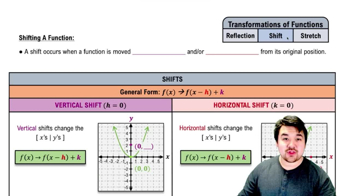
Function Transformation - Horizontal Shifts

A horizontal shift of a function occurs when the input variable x is replaced by (x - h), where h is a constant. This shifts the graph of the function h units to the right if h is positive, and h units to the left if h is negative. For example, y = f(x - 2) shifts the graph of y = f(x) two units to the right.
Recommended video:
5:34
Shifts of Functions

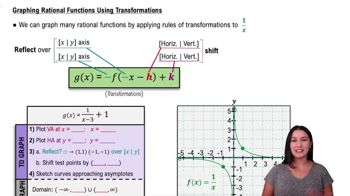
Graphing Functions Using Key Points

To graph a transformed function, it is helpful to identify and shift key points from the original graph. Each point (x, y) on the original graph moves to (x + h, y) for a horizontal shift by h units. Plotting these new points and connecting them helps visualize the transformed function accurately.
Recommended video:
5:31
Graphing Rational Functions Using Transformations

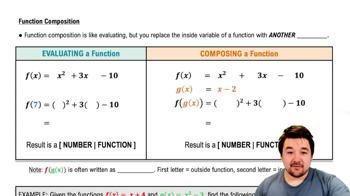
Interpreting Piecewise or Composite Graphs

When a function graph consists of multiple segments or shapes, each segment must be transformed consistently. Understanding how each part behaves and shifts ensures the entire graph is correctly redrawn after transformation, preserving the shape and relative positions of all segments.
Recommended video:
4:56
Function Composition