Ch. 2 - Graphs and Functions
Lial - College Algebra 13th Edition
Lial13th EditionCollege AlgebraISBN: 9780136881063Not the one you use?Change textbook
Chapter 3, Problem 97

Each of the following graphs is obtained from the graph of ƒ(x)=|x| or g(x)=√x by applying several of the transformations discussed in this section. Describe the transformations and give an equation for the graph.
Graph showing transformations of f(x)=|x|, with a red V-shape and vertex at (-2,-6).

Verified step by step guidance
1
Identify the parent function: The original graph is based on the function \(f(x) = |x|\), which has a vertex at the origin \((0,0)\) and a V-shape.
Determine the vertex of the transformed graph: From the graph, the vertex is located at \((-2, -6)\), indicating a horizontal and vertical shift from the origin.
Describe the horizontal shift: Since the vertex moved from \(x=0\) to \(x=-2\), this corresponds to a shift 2 units to the left. This is represented inside the absolute value as \(|x + 2|\).
Describe the vertical shift: The vertex moved from \(y=0\) to \(y=-6\), which is a downward shift of 6 units. This is represented by subtracting 6 outside the absolute value, as \(-6\).
Write the equation of the transformed graph: Combining the shifts, the equation is \(f(x) = |x + 2| - 6\).

Verified video answer for a similar problem:

This video solution was recommended by our tutors as helpful for the problem above.
Video duration:
1m
Was this helpful?

Key Concepts

Here are the essential concepts you must grasp in order to answer the question correctly.

Absolute Value Function

The absolute value function, f(x) = |x|, produces a V-shaped graph with its vertex at the origin (0,0). It outputs the distance of x from zero, making all values non-negative. Understanding this base graph is essential for identifying transformations such as shifts, stretches, or reflections.
Recommended video:
4:56
Function Composition

Transformations of Functions

Transformations include translations (shifts), reflections, stretches, and compressions applied to the base graph. Horizontal shifts move the graph left or right, vertical shifts move it up or down, and reflections flip it across axes. Recognizing these changes helps write the equation of the transformed graph.
Recommended video:
4:22
Domain & Range of Transformed Functions

Vertex Form and Graph Translation

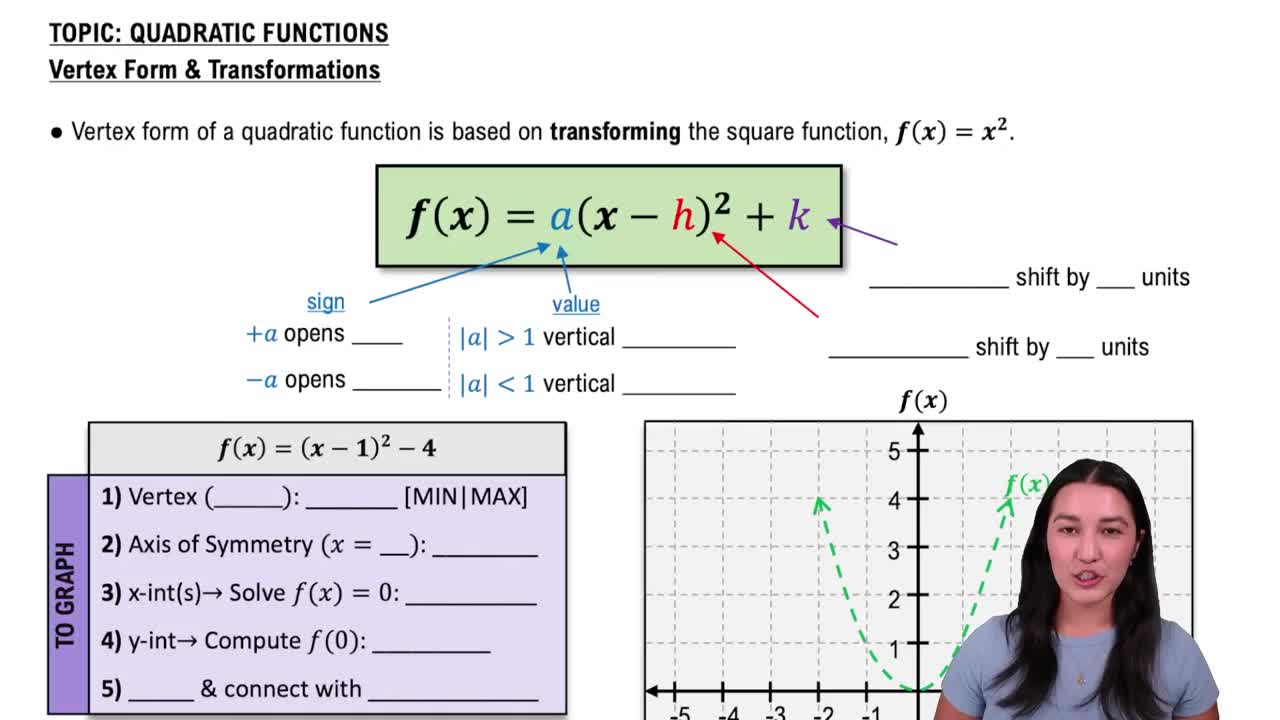
The vertex form of an absolute value function is f(x) = a|x - h| + k, where (h, k) is the vertex. This form directly shows horizontal and vertical shifts from the origin. Identifying the vertex on the graph allows you to determine h and k, which are crucial for writing the equation of the transformed function.
Recommended video:
08:07
Vertex Form