Each of the following graphs is obtained from the graph of ƒ(x)=|x| or g(x)=√x by applying several of the transformations discussed in this section. Describe the transformations and give an equation for the graph.
Ch. 2 - Graphs and Functions

Chapter 3, Problem 95
Describe how the graph of each function can be obtained from the graph of ƒ(x) = |x|. g(x) = -|x|
Verified step by step guidance1
Start with the basic graph of the function \(f(x) = |x|\), which is a V-shaped graph opening upwards with its vertex at the origin \((0,0)\).
Recognize that the function \(g(x) = -|x|\) involves multiplying the output of \(f(x)\) by \(-1\), which affects the vertical direction of the graph.
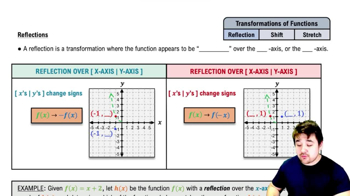
Multiplying by \(-1\) reflects the graph of \(f(x) = |x|\) across the x-axis, turning all positive y-values into negative y-values and vice versa.
Therefore, the graph of \(g(x) = -|x|\) is a V-shaped graph opening downwards with its vertex still at the origin \((0,0)\).
In summary, to obtain the graph of \(g(x) = -|x|\) from \(f(x) = |x|\), reflect the entire graph of \(f(x)\) over the x-axis.

Verified video answer for a similar problem:
This video solution was recommended by our tutors as helpful for the problem above.
Video duration:
1mWas this helpful?
Key Concepts
Here are the essential concepts you must grasp in order to answer the question correctly.
Absolute Value Function
The absolute value function, f(x) = |x|, outputs the distance of x from zero, always producing non-negative values. Its graph is a V-shaped curve with the vertex at the origin (0,0), opening upwards. Understanding this base graph is essential for analyzing transformations applied to it.
Recommended video:
Function Composition
Reflection Across the x-axis
Multiplying a function by -1 reflects its graph across the x-axis. For g(x) = -|x|, this means the V-shaped graph of |x| is flipped upside down, opening downward. This transformation changes all positive y-values to negative, altering the graph's orientation.
Recommended video:
Reflections of Functions
Graph Transformations
Graph transformations involve shifting, stretching, compressing, or reflecting a base graph to obtain a new graph. Recognizing how operations like negation affect the original function helps in sketching and understanding the new function's behavior quickly and accurately.
Recommended video:
Intro to Transformations
Related Practice
Textbook Question
Textbook Question
Given functions f and g, find (a)(ƒ∘g)(x) and its domain, and (b)(g∘ƒ)(x) and its domain. ƒ(x)=1/(x+4), g(x)=-(1/x)
Textbook Question
What is the relationship between the graphs of ƒ(x)=|x| and g(x)=|-x|?
Textbook Question
For each function graphed, give the minimum and maximum values of ƒ(x) and the x-values at which they occur.
1
views
Textbook Question
Determine whether each equation has a graph that is symmetric with respect to the x-axis, the y-axis, the origin, or none of these. |x| = |y|
1
views
Textbook Question
Each of the following graphs is obtained from the graph of ƒ(x)=|x| or g(x)=√x by applying several of the transformations discussed in this section. Describe the transformations and give an equation for the graph.