Ch. 8 - Techniques of Integration
Hass - Thomas' Calculus 15th Edition
Hass15th EditionThomas' CalculusISBN: 9780137616077Not the one you use?Change textbook
Chapter 8, Problem 8.AAE.34

Use the substitutions in Equations (1)–(4) to evaluate the integrals in Exercises 33–40. Integrals like these arise in calculating the average angular velocity of the output shaft of a universal joint when the input and output shafts are not aligned.
∫ dx / (1 + sin x + cos x)

Verified step by step guidance
1
Start by recognizing that the integral involves trigonometric functions in the denominator: \(\int \frac{dx}{1 + \sin x + \cos x}\).
Use the Weierstrass substitution, which is a common technique for integrals involving sine and cosine. Set \(t = \tan\left(\frac{x}{2}\right)\), which implies the following substitutions:
\[\sin x = \frac{2t}{1 + t^2}, \quad \cos x = \frac{1 - t^2}{1 + t^2}, \quad dx = \frac{2}{1 + t^2} dt.\]
Rewrite the integral in terms of \(t\) by substituting \(\sin x\), \(\cos x\), and \(dx\) into the integral:
\[\int \frac{dx}{1 + \sin x + \cos x} = \int \frac{\frac{2}{1 + t^2} dt}{1 + \frac{2t}{1 + t^2} + \frac{1 - t^2}{1 + t^2}}.\]
Simplify the denominator by combining the terms over the common denominator \(1 + t^2\), then simplify the entire integrand to a rational function in \(t\). After simplification, integrate the resulting rational function with respect to \(t\).

Verified video answer for a similar problem:

This video solution was recommended by our tutors as helpful for the problem above.
Video duration:
11m
Was this helpful?

Key Concepts

Here are the essential concepts you must grasp in order to answer the question correctly.

Trigonometric Substitution

Trigonometric substitution involves replacing expressions involving sine and cosine with equivalent forms using identities or auxiliary variables. This technique simplifies integrals containing trigonometric functions by transforming them into more manageable algebraic forms, making integration possible.
Recommended video:
6:04
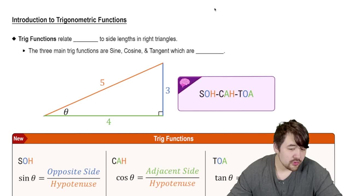
Introduction to Trigonometric Functions

Trigonometric Identities

Trigonometric identities like sin²x + cos²x = 1, and sum-to-product formulas help rewrite complex expressions into simpler ones. Using these identities allows the integral's denominator to be expressed in a form that is easier to integrate or substitute.
Recommended video:
7:17
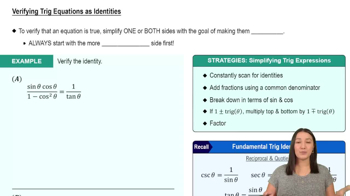
Verifying Trig Equations as Identities

Integration Techniques for Rational Functions

After substitution, the integral often reduces to a rational function of a new variable. Techniques such as partial fraction decomposition or standard integral formulas for rational functions are then used to evaluate the integral efficiently.
Recommended video:
6:04
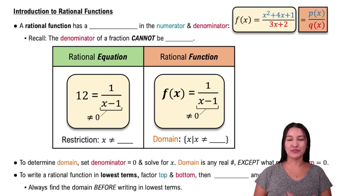
Intro to Rational Functions