
Ch. 8 - Techniques of Integration
Hass - Thomas' Calculus 15th Edition
Hass15th EditionThomas' CalculusISBN: 9780137616077Not the one you use?Change textbook
Chapter 8, Problem 8.AAE.20

Finding volume
The infinite region bounded by the coordinate axes and the curve y = −ln x in the first quadrant is revolved about the x-axis to generate a solid. Find the volume of the solid.

Verified step by step guidance
1
Identify the region bounded by the coordinate axes and the curve \(y = -\ln x\) in the first quadrant. Since \(y = -\ln x\), and we are in the first quadrant, \(x\) ranges from 0 to 1 because \(\ln x\) is negative for \(0 < x < 1\) and \(y\) is positive there.
Set up the volume integral using the method of disks/washers. When revolving around the x-axis, the volume element is \(dV = \pi [f(x)]^2 dx\), where \(f(x)\) is the radius of the disk. Here, the radius is \(y = -\ln x\).
Write the volume integral as \(V = \pi \int_0^1 (-\ln x)^2 \, dx\). This integral represents the volume of the solid generated by revolving the region around the x-axis.
To evaluate the integral \(\int_0^1 (-\ln x)^2 \, dx\), consider using the substitution \(t = -\ln x\), which implies \(x = e^{-t}\) and \(dx = -e^{-t} dt\). Change the limits accordingly: when \(x=0^+\), \(t \to \infty\), and when \(x=1\), \(t=0\).
Rewrite the integral in terms of \(t\) and evaluate it using integration techniques for exponential and polynomial functions. This will give the volume of the solid.

Verified video answer for a similar problem:

This video solution was recommended by our tutors as helpful for the problem above.
Video duration:
6m
Was this helpful?

Key Concepts

Here are the essential concepts you must grasp in order to answer the question correctly.

Volume of Solids of Revolution

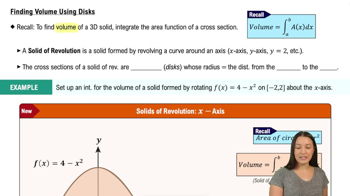
This concept involves finding the volume of a 3D solid formed by rotating a 2D region around an axis. The disk or washer method is commonly used, where the volume is computed by integrating the cross-sectional area perpendicular to the axis of rotation.
Recommended video:
04:48
Finding Volume Using Disks

Natural Logarithm Function and Its Properties

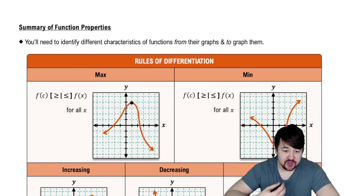
The function y = -ln(x) is defined for x > 0 and decreases as x increases. Understanding its behavior and domain is essential to correctly set up the limits of integration and the shape of the region bounded by the axes and the curve.
Recommended video:
06:21
Properties of Functions

Definite Integration and Limits of Integration

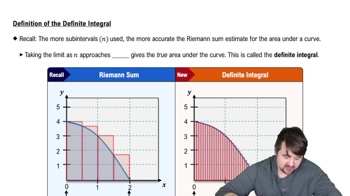
Definite integrals calculate the accumulated area or volume between specified bounds. Identifying the correct limits, especially for improper integrals when the region extends to infinity, is crucial for accurately computing the volume.
Recommended video:
05:43
Definition of the Definite Integral