
Ch. 8 - Techniques of Integration
Hass - Thomas' Calculus 15th Edition
Hass15th EditionThomas' CalculusISBN: 9780137616077Not the one you use?Change textbook
Chapter 8, Problem 8.AAE.9

Evaluate the limits in Exercise 9 and 10 by identifying them with definite integrals and evaluating the integrals.
lim (n → ∞) Σ (from k=1 to n) ln √(1 + k/n)

Verified step by step guidance
1
Recognize that the given limit is a Riemann sum of the form \(\lim_{n \to \infty} \sum_{k=1}^n f\left(\frac{k}{n}\right) \Delta x\), where \(\Delta x = \frac{1}{n}\) and \(f(x) = \ln \sqrt{1 + x}\).
Rewrite the summand \(\ln \sqrt{1 + \frac{k}{n}}\) as \(\frac{1}{2} \ln \left(1 + \frac{k}{n}\right)\) to simplify the expression inside the sum.
Express the sum as \(\sum_{k=1}^n \frac{1}{2} \ln \left(1 + \frac{k}{n}\right) \cdot \frac{1}{n}\), which matches the form of a Riemann sum for the integral of \(\frac{1}{2} \ln(1 + x)\) over the interval \([0,1]\).
Set up the definite integral corresponding to the limit: \(\int_0^1 \frac{1}{2} \ln(1 + x) \, dx\).
Evaluate the integral \(\int_0^1 \frac{1}{2} \ln(1 + x) \, dx\) using integration techniques such as integration by parts to find the exact value representing the limit.

Verified video answer for a similar problem:

This video solution was recommended by our tutors as helpful for the problem above.
Video duration:
9m
Was this helpful?

Key Concepts

Here are the essential concepts you must grasp in order to answer the question correctly.

Definite Integral as a Limit of Riemann Sums

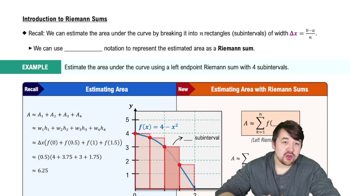
A definite integral can be interpreted as the limit of a sum of function values times small intervals, known as a Riemann sum. As the number of subintervals increases indefinitely, the sum approaches the exact area under the curve. Recognizing a limit of sums as a definite integral is key to evaluating such limits.
Recommended video:
06:11
Introduction to Riemann Sums

Properties of Logarithmic Functions

Logarithmic functions, such as ln(x), have properties that simplify expressions, like ln(√x) = (1/2)ln(x). Understanding these properties helps in rewriting the sum's terms into a more manageable form, facilitating the identification of the integrand in the limit process.
Recommended video:
06:21
Properties of Functions

Limit of a Sequence and Continuity

Evaluating limits involving sequences often requires understanding how functions behave as their inputs approach a point. Continuity ensures that the limit of the function values equals the function value at the limit point, allowing substitution inside the integral after identifying the integrand.
Recommended video:
Guided course
8:22
Introduction to Sequences