Ch. 8 - Techniques of Integration
Hass - Thomas' Calculus 15th Edition
Hass15th EditionThomas' CalculusISBN: 9780137616077Not the one you use?Change textbook
Chapter 8, Problem 8.AAE.17a

Finding volume
Let R be the "triangular" region in the first quadrant that is bounded above by the line y = 1, below by the curve y = ln x, and on the left by the line x = 1.
Find the volume of the solid generated by revolving R about
a. the x-axis.

Verified step by step guidance
1
First, identify the region R bounded by the curves: above by \(y = 1\), below by \(y = \ln x\), and on the left by \(x = 1\). Since \(y = \ln x\) is defined for \(x > 0\), and the region is in the first quadrant, determine the right boundary by finding the \(x\)-value where \(y = 1\) intersects \(y = \ln x\). Solve \(\ln x = 1\) to find this \(x\)-value.
Set up the volume integral using the method of washers (disks with holes) since the region is revolved around the x-axis. The volume element is given by \(\pi \times (\text{outer radius}^2 - \text{inner radius}^2) \, dx\) where the outer radius is the distance from the x-axis to the upper curve and the inner radius is the distance from the x-axis to the lower curve.
In this problem, the outer radius is the distance from the x-axis to \(y = 1\), which is simply 1, and the inner radius is the distance from the x-axis to \(y = \ln x\). So the volume integral becomes \(V = \int_{x=1}^{x=e} \pi \left(1^2 - (\ln x)^2\right) \, dx\) where \(e\) is the solution from step 1.
Write the integral explicitly as \(V = \pi \int_1^{e} \left(1 - (\ln x)^2\right) \, dx\). This integral represents the volume of the solid generated by revolving the region R about the x-axis.
To solve the integral, split it into two parts: \(\pi \int_1^{e} 1 \, dx - \pi \int_1^{e} (\ln x)^2 \, dx\). The first integral is straightforward, and the second integral can be solved using integration by parts or a known formula for \(\int (\ln x)^n \, dx\). After evaluating both integrals, combine the results to express the volume.

Verified video answer for a similar problem:

This video solution was recommended by our tutors as helpful for the problem above.
Video duration:
5m
Was this helpful?

Key Concepts

Here are the essential concepts you must grasp in order to answer the question correctly.

Region Bounded by Curves

Understanding the region R requires identifying the area enclosed by the given curves and lines: y = 1 (a horizontal line), y = ln(x) (a logarithmic curve), and x = 1 (a vertical line). This helps determine the limits of integration and the shape of the region to be revolved.
Recommended video:
05:06
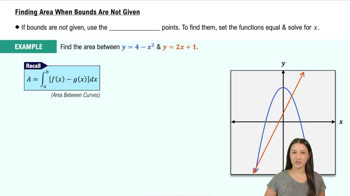
Finding Area When Bounds Are Not Given

Volume of Solids of Revolution

When a region is revolved around an axis, it generates a 3D solid. The volume can be found using methods like the disk/washer method, which involves integrating cross-sectional areas perpendicular to the axis of revolution.
Recommended video:
04:48
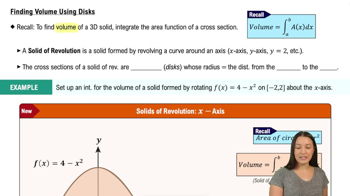
Finding Volume Using Disks

Disk/Washer Method

This method calculates volume by slicing the solid into thin disks or washers. For revolution about the x-axis, the radius of each disk is the vertical distance from the axis to the curve, and the volume is the integral of π times the radius squared over the interval.
Recommended video:
06:30
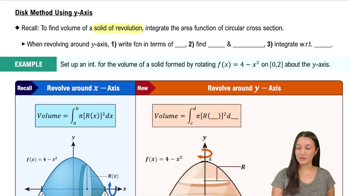
Disk Method Using y-Axis