
2. When applying the formula for integration by parts, how do you choose the u and dv? How can you apply integration by parts to an integral of the form ∫ f(x) dx?
Ch. 8 - Techniques of Integration
Chapter 8, Problem 8.GYR.7
7. What is the goal of the method of partial fractions?
Verified step by step guidance1
Understand that the method of partial fractions is used to decompose a complex rational function into a sum of simpler rational expressions whose denominators are factors of the original denominator.
Recognize that this decomposition makes it easier to perform operations such as integration or inverse Laplace transforms on the original rational function.
Identify the denominator of the given rational function and factor it completely into linear and/or irreducible quadratic factors.
Express the original rational function as a sum of fractions, each with one of the factors in the denominator and unknown constants in the numerators.
Solve for the unknown constants by multiplying both sides by the common denominator and equating coefficients or substituting convenient values of the variable.

Verified video answer for a similar problem:
This video solution was recommended by our tutors as helpful for the problem above.
Video duration:
1mWas this helpful?
Key Concepts
Here are the essential concepts you must grasp in order to answer the question correctly.
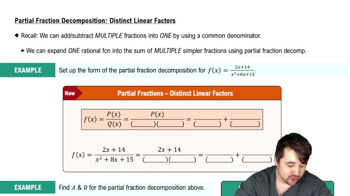
Partial Fraction Decomposition
Partial fraction decomposition is a technique used to express a complex rational function as a sum of simpler fractions. This simplification makes integration and other operations easier by breaking down complicated expressions into manageable parts.
Recommended video:
Partial Fraction Decomposition: Distinct Linear Factors
Rational Functions
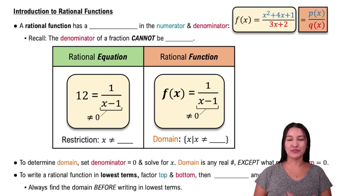
A rational function is a ratio of two polynomials. Understanding the structure of rational functions is essential because partial fractions apply specifically to these types of functions, allowing us to rewrite them in simpler forms.
Recommended video:
Intro to Rational Functions
Integration of Rational Functions
One primary goal of partial fractions is to facilitate the integration of rational functions. By decomposing a complex fraction into simpler terms, each term can be integrated using basic integral formulas, making the overall integration process more straightforward.
Recommended video:
Intro to Rational Functions
Related Practice
Textbook Question
Textbook Question
Evaluate the limits in Exercise 9 and 10 by identifying them with definite integrals and evaluating the integrals.
lim (n → ∞) Σ (from k=1 to n) ln √(1 + k/n)
Textbook Question
Evaluate the limits in Exercise 7 and 8.
lim (x → ∞) ∫₋ˣ^ˣ sin t dt
1
views
Textbook Question
Evaluate the integrals in Exercises 69–134. The integrals are listed in random order so you need to decide which integration technique to use.
127. ∫ (ln x) / (x + x ln x) dx
1
views
Textbook Question
Evaluate the integrals in Exercises 69–134. The integrals are listed in random order so you need to decide which integration technique to use.
∫ x dx / √(2 − x)
Textbook Question
Evaluate the integrals in Exercises 9–28. It may be necessary to use a substitution first.
∫ [(x + 1) / (x² (x − 1))] dx
1
views
