
Ch. 8 - Techniques of Integration
Hass - Thomas' Calculus 15th Edition
Hass15th EditionThomas' CalculusISBN: 9780137616077Not the one you use?Change textbook
Chapter 8, Problem 8.AAE.28

For each x > 0, let G(x) = ∫(from 0 to x) e^(-xt) dt. Prove that xG(x) = 1 for each x > 0.

Verified step by step guidance
1
Start by writing down the definition of the function \( G(x) \): \[ G(x) = \int_0^x e^{-x t} \, dt \] Note that the integrand depends on both \( x \) and \( t \).
To find \( x G(x) \), multiply both sides of the equation by \( x \): \[ x G(x) = x \int_0^x e^{-x t} \, dt \] Our goal is to show this expression equals 1 for all \( x > 0 \).
Use the Leibniz rule for differentiation under the integral sign to differentiate \( G(x) \) with respect to \( x \). Since the upper limit and the integrand both depend on \( x \), the derivative is: \[ G'(x) = e^{-x \cdot x} \cdot 1 + \int_0^x \frac{\partial}{\partial x} e^{-x t} \, dt \] Here, the first term comes from differentiating the upper limit, and the second term is the integral of the partial derivative of the integrand.
Calculate the partial derivative inside the integral: \[ \frac{\partial}{\partial x} e^{-x t} = -t e^{-x t} \] Substitute this back into the expression for \( G'(x) \): \[ G'(x) = e^{-x^2} - \int_0^x t e^{-x t} \, dt \]
Now, consider the derivative of \( x G(x) \) using the product rule: \[ \frac{d}{dx} (x G(x)) = G(x) + x G'(x) \] Substitute \( G'(x) \) from the previous step and simplify. You will find that this derivative equals zero, implying \( x G(x) \) is constant. Finally, evaluate \( x G(x) \) at \( x = 0 \) (using a limit if necessary) to find the constant equals 1, completing the proof.

Verified video answer for a similar problem:

This video solution was recommended by our tutors as helpful for the problem above.
Video duration:
4m
Was this helpful?

Key Concepts

Here are the essential concepts you must grasp in order to answer the question correctly.

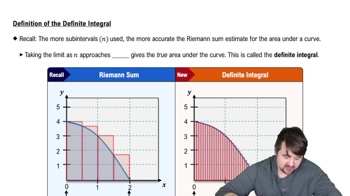
Definite Integral with Variable Limits

A definite integral with variable limits involves integrating a function where the upper or lower limit depends on a variable. Understanding how to evaluate such integrals and how the limits affect the integral's value is essential, especially when the integrand also depends on the variable of integration and the limit.
Recommended video:
05:43
Definition of the Definite Integral

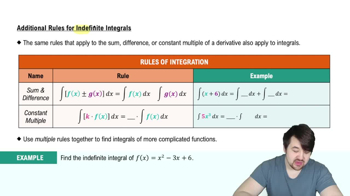
Differentiation Under the Integral Sign (Leibniz Rule)

This technique allows differentiation of an integral whose integrand and limits depend on a parameter. It provides a formula to differentiate with respect to that parameter, which is crucial for analyzing functions defined by integrals like G(x) and proving identities involving them.
Recommended video:
05:56
Additional Rules for Indefinite Integrals

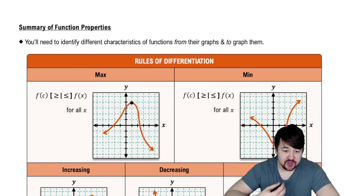
Exponential Function Properties

The exponential function e^(-xt) has properties such as continuous differentiability and integrability that simplify calculations. Recognizing how the exponent's variables interact helps in manipulating the integral and proving relationships like xG(x) = 1.
Recommended video:
06:21
Properties of Functions