Ch. 8 - Techniques of Integration
Hass - Thomas' Calculus 15th Edition
Hass15th EditionThomas' CalculusISBN: 9780137616077Not the one you use?Change textbook
Chapter 8, Problem 8.AAE.38

Use the substitutions in Equations (1)–(4) to evaluate the integrals in Exercises 33–40. Integrals like these arise in calculating the average angular velocity of the output shaft of a universal joint when the input and output shafts are not aligned.
∫(from π/2 to 2π/3) cos θ dθ / (sin θ cos θ + sin θ)

Verified step by step guidance
1
First, examine the integral: \(\int_{\pi/2}^{2\pi/3} \frac{\cos \theta \, d\theta}{\sin \theta \cos \theta + \sin \theta}\). Notice the denominator can be factored to simplify the expression.
Factor the denominator: \(\sin \theta \cos \theta + \sin \theta = \sin \theta (\cos \theta + 1)\). So the integral becomes \(\int_{\pi/2}^{2\pi/3} \frac{\cos \theta}{\sin \theta (\cos \theta + 1)} \, d\theta\).
Consider a substitution to simplify the integral. Since both \(\sin \theta\) and \(\cos \theta\) appear, try substituting \(u = \sin \theta\) or \(u = \cos \theta + 1\). Calculate \(du\) accordingly to see which substitution simplifies the integral best.
If you choose \(u = \cos \theta + 1\), then \(du = -\sin \theta \, d\theta\). Rearranging, \(-du = \sin \theta \, d\theta\). This matches part of the denominator and the differential, so rewrite the integral in terms of \(u\).
Rewrite the integral using the substitution and adjust the limits of integration accordingly by plugging in the original \(\theta\) limits into \(u = \cos \theta + 1\). Then, express the integral fully in terms of \(u\) and integrate.

Verified video answer for a similar problem:

This video solution was recommended by our tutors as helpful for the problem above.
Video duration:
7m
Was this helpful?

Key Concepts

Here are the essential concepts you must grasp in order to answer the question correctly.

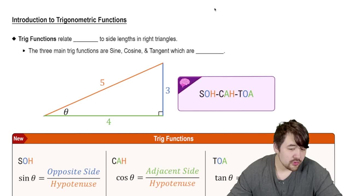
Trigonometric Substitution

Trigonometric substitution involves replacing parts of an integral with trigonometric expressions to simplify the integrand. This technique is useful when the integral contains products or sums of sine and cosine functions, allowing the integral to be rewritten in a more manageable form.
Recommended video:
6:04
Introduction to Trigonometric Functions

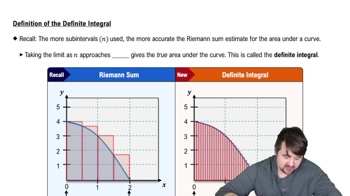
Definite Integrals and Limits of Integration

Definite integrals calculate the net area under a curve between two specific points, called limits of integration. Understanding how to apply these limits after substitution is crucial to correctly evaluate the integral's numerical value.
Recommended video:
05:43
Definition of the Definite Integral

Simplification of Rational Trigonometric Expressions

Simplifying rational expressions involving trigonometric functions often requires factoring, using identities, or algebraic manipulation. This step is essential to reduce the integral into a form that can be integrated directly or through substitution.
Recommended video:
6:04
Introduction to Trigonometric Functions