Ch. 8 - Techniques of Integration
Hass - Thomas' Calculus 15th Edition
Hass15th EditionThomas' CalculusISBN: 9780137616077Not the one you use?Change textbook
Chapter 8, Problem 8.AAE.24

Finding surface area
Find the area of the surface generated by revolving the curve in Exercise 23 about the y-axis.

Verified step by step guidance
1
Identify the curve from Exercise 23. Since the problem references a previous exercise, first write down the explicit function \( y = f(x) \) or parametric equations given in that exercise.
Recall the formula for the surface area \( S \) generated by revolving a curve \( y = f(x) \) about the y-axis from \( x = a \) to \( x = b \): \[ S = \int_a^b 2\pi x \sqrt{1 + \left(\frac{dy}{dx}\right)^2} \, dx \] This formula uses the radius \( x \) (distance from the y-axis) and the arc length element.
Compute the derivative \( \frac{dy}{dx} \) of the function \( y = f(x) \). This is necessary to find the integrand's square root term.
Set up the integral by substituting \( x \), \( \frac{dy}{dx} \), and the limits of integration \( a \) and \( b \) into the surface area formula.
Evaluate the integral (or simplify it as much as possible) to express the surface area. If the integral is complicated, consider substitution or numerical methods, but do not compute the final value here.

Verified video answer for a similar problem:

This video solution was recommended by our tutors as helpful for the problem above.
Video duration:
4m
Was this helpful?

Key Concepts

Here are the essential concepts you must grasp in order to answer the question correctly.

Surface Area of Revolution

The surface area of a solid formed by revolving a curve around an axis is found using an integral formula. For revolution about the y-axis, the formula involves integrating 2π times the radius (distance from the y-axis) times the arc length differential. This captures the 'wrapped' surface created by the rotating curve.
Recommended video:
09:07
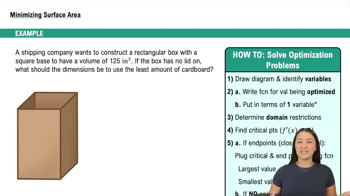
Example 1: Minimizing Surface Area

Parametric or Function Representation of Curves

To compute surface area, the curve must be expressed as a function or parametric equations. This allows calculation of derivatives and arc length elements. Understanding how to represent the curve from Exercise 23 is essential to set up the integral correctly.
Recommended video:
06:49
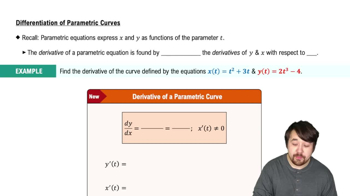
Differentiation of Parametric Curves

Arc Length Differential

The arc length differential, ds, measures an infinitesimal segment of the curve and is given by √(dx/dt)² + (dy/dt)² dt or √(1 + (dy/dx)²) dx. It is crucial for integrating along the curve to find surface area, as it accounts for the curve's shape and length.
Recommended video:
06:29
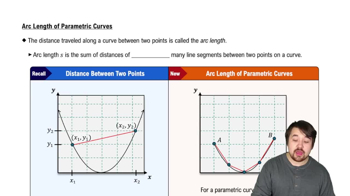
Arc Length of Parametric Curves