2. When applying the formula for integration by parts, how do you choose the u and dv? How can you apply integration by parts to an integral of the form ∫ f(x) dx?
Ch. 8 - Techniques of Integration
Chapter 8, Problem 8.AAE.7
Evaluate the limits in Exercise 7 and 8.
lim (x → ∞) ∫₋ˣ^ˣ sin t dt
Verified step by step guidance1
Recognize that the problem asks for the limit as \(x\) approaches infinity of the integral \(\int_{-x}^{x} \sin t \, dt\).
Recall the Fundamental Theorem of Calculus, which tells us how to evaluate definite integrals using antiderivatives.
Find the antiderivative of \(\sin t\), which is \(-\cos t\).
Evaluate the definite integral \(\int_{-x}^{x} \sin t \, dt\) by computing \([-\cos t]_{-x}^{x} = -\cos x - (-\cos(-x))\).
Use the fact that cosine is an even function, so \(\cos(-x) = \cos x\), and simplify the expression before taking the limit as \(x \to \infty\).

Verified video answer for a similar problem:
This video solution was recommended by our tutors as helpful for the problem above.
Video duration:
2mWas this helpful?
Key Concepts
Here are the essential concepts you must grasp in order to answer the question correctly.
Definite Integral and its Geometric Interpretation
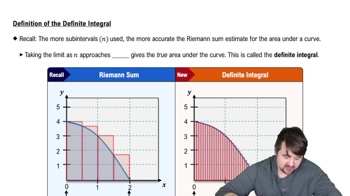
A definite integral represents the net area under a curve between two limits. In this problem, the integral of sin(t) from -x to x measures the accumulated area under the sine curve over a symmetric interval, which is essential for understanding how the integral behaves as x approaches infinity.
Recommended video:
Definition of the Definite Integral
Limit of a Function as x Approaches Infinity
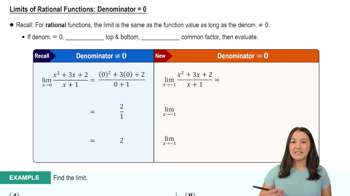
The limit as x approaches infinity examines the behavior of a function or expression when x grows without bound. Here, evaluating lim (x → ∞) ∫₋ˣ^ˣ sin t dt requires understanding how the integral changes as the interval expands indefinitely.
Recommended video:
Limits of Rational Functions: Denominator = 0
Properties of the Sine Function and its Integral
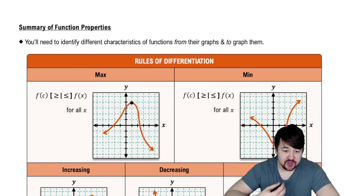
The sine function is periodic and oscillates between -1 and 1. Its integral over symmetric intervals often cancels out due to its odd symmetry, which is crucial for evaluating the limit of the integral from -x to x as x tends to infinity.
Recommended video:
Properties of Functions
Related Practice
Textbook Question
Textbook Question
Finding surface area
Find the area of the surface generated by revolving the curve in Exercise 23 about the y-axis.
1
views

Textbook Question
Evaluate the limits in Exercise 9 and 10 by identifying them with definite integrals and evaluating the integrals.
lim (n → ∞) Σ (from k=1 to n) ln √(1 + k/n)
Textbook Question
Length of a curve
Find the length of the curve
y = ∫(from 1 to x) sqrt(sqrt(t) - 1) dt, where 1 ≤ x ≤ 16.
1
views
Textbook Question
7. What is the goal of the method of partial fractions?
Textbook Question
Evaluate the integrals in Exercises 69–134. The integrals are listed in random order so you need to decide which integration technique to use.
∫ x dx / √(2 − x)