Ch. 8 - Techniques of Integration
Hass - Thomas' Calculus 15th Edition
Hass15th EditionThomas' CalculusISBN: 9780137616077Not the one you use?Change textbook
Chapter 8, Problem 8.AAE.11

Finding arc length
Find the length of the curve
y = ∫ from 0 to x of √(cos(2t)) dt, 0 ≤ x ≤ π/4.

Verified step by step guidance
1
Recognize that the curve is defined by an integral function: \(y = \int_0^x \sqrt{\cos(2t)} \, dt\). To find the arc length of \(y\) from \(x=0\) to \(x=\frac{\pi}{4}\), we use the arc length formula for a function \(y=f(x)\): \(L = \int_a^b \sqrt{1 + \left(\frac{dy}{dx}\right)^2} \, dx\).
Find the derivative \(\frac{dy}{dx}\) using the Fundamental Theorem of Calculus. Since \(y\) is defined as an integral with variable upper limit \(x\), we have \(\frac{dy}{dx} = \sqrt{\cos(2x)}\).
Substitute \(\frac{dy}{dx}\) into the arc length formula: \(L = \int_0^{\frac{\pi}{4}} \sqrt{1 + \left(\sqrt{\cos(2x)}\right)^2} \, dx\).
Simplify the expression inside the square root: \(\left(\sqrt{\cos(2x)}\right)^2 = \cos(2x)\), so the integrand becomes \(\sqrt{1 + \cos(2x)}\).
Use a trigonometric identity to simplify \(1 + \cos(2x)\). Recall that \(1 + \cos(2x) = 2 \cos^2(x)\). Therefore, the integrand simplifies to \(\sqrt{2 \cos^2(x)} = \sqrt{2} |\cos(x)|\). Since \(x\) is in \([0, \frac{\pi}{4}]\) where \(\cos(x)\) is positive, the absolute value can be removed. The arc length integral becomes \(L = \int_0^{\frac{\pi}{4}} \sqrt{2} \cos(x) \, dx\).

Verified video answer for a similar problem:

This video solution was recommended by our tutors as helpful for the problem above.
Video duration:
4m
Was this helpful?

Key Concepts

Here are the essential concepts you must grasp in order to answer the question correctly.

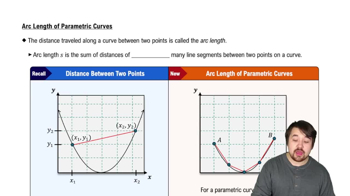
Arc Length Formula for Parametric and Integral-Defined Curves

The arc length of a curve y = f(x) from a to b is given by the integral of the square root of 1 plus the derivative squared, ∫_a^b √(1 + (dy/dx)^2) dx. When y is defined as an integral function, this formula still applies by first finding dy/dx.
Recommended video:
06:29
Arc Length of Parametric Curves

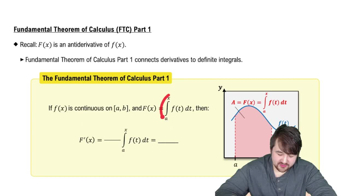
Fundamental Theorem of Calculus

This theorem connects differentiation and integration, stating that if y = ∫_0^x g(t) dt, then dy/dx = g(x). It allows us to find the derivative of an integral-defined function, which is essential for computing the arc length.
Recommended video:
06:11
Fundamental Theorem of Calculus Part 1

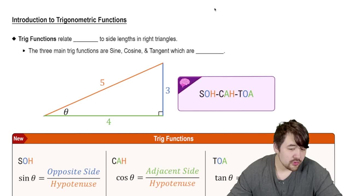
Handling Square Roots of Trigonometric Functions

The integrand involves √(cos(2t)), which requires understanding the domain where cos(2t) is non-negative to ensure the square root is real. Recognizing trigonometric identities and domain restrictions helps in evaluating or simplifying the integral.
Recommended video:
6:04
Introduction to Trigonometric Functions