Ch. 8 - Techniques of Integration
Hass - Thomas' Calculus 15th Edition
Hass15th EditionThomas' CalculusISBN: 9780137616077Not the one you use?Change textbook
Chapter 8, Problem 8.AAE.22

Centroid of a region
Find the centroid of the region in the plane enclosed by the curves y = ±(1 − x²)^(-1/2) and the lines x = 0 and x = 1.

Verified step by step guidance
1
Identify the region bounded by the curves and lines. The curves are given by \(y = \pm (1 - x^2)^{-1/2}\), and the vertical boundaries are \(x = 0\) and \(x = 1\). This region is symmetric about the x-axis because of the \(\pm\) sign.
Set up the expressions for the area \(A\) of the region. Since the region is symmetric about the x-axis, the total area can be found by integrating the upper curve and doubling it: \(A = 2 \int_0^1 (1 - x^2)^{-1/2} \, dx\).
Write the formulas for the coordinates of the centroid \((\bar{x}, \bar{y})\). Because of symmetry about the x-axis, \(\bar{y} = 0\). The \(x\)-coordinate of the centroid is given by \(\bar{x} = \frac{1}{A} \int_0^1 x \cdot 2(1 - x^2)^{-1/2} \, dx\).
Evaluate the integrals for the area \(A\) and the moment integral for \(\bar{x}\). Use an appropriate substitution such as \(x = \sin \theta\) to simplify the integrals involving \((1 - x^2)^{-1/2}\).
After computing the integrals symbolically, substitute the results back into the formula for \(\bar{x}\) to express the centroid coordinates as \((\bar{x}, 0)\).

Verified video answer for a similar problem:

This video solution was recommended by our tutors as helpful for the problem above.
Video duration:
4m
Was this helpful?

Key Concepts

Here are the essential concepts you must grasp in order to answer the question correctly.

Centroid of a Region

The centroid is the geometric center or 'balance point' of a planar region. It is found by calculating the average position of all points in the region, typically using integrals to find the coordinates (x̄, ȳ). For regions bounded by curves, the centroid coordinates are given by the moments of area divided by the total area.
Recommended video:
07:45
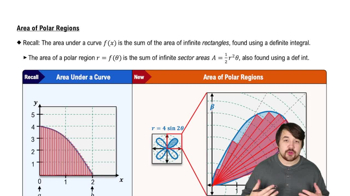
Area of Polar Regions

Definite Integrals for Area and Moments

Definite integrals are used to compute the area under curves and the moments needed to find the centroid. The area is found by integrating the difference between the bounding functions, while moments involve integrating the product of the coordinate and the function. These integrals are evaluated over the given interval, here from x = 0 to x = 1.
Recommended video:
05:43
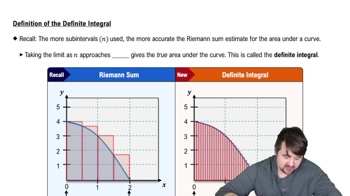
Definition of the Definite Integral

Handling Curves Defined by y = ±(1 − x²)^(-1/2)

The curves y = ±(1 − x²)^(-1/2) represent the upper and lower branches of a function with vertical asymptotes at x = ±1. Understanding their behavior and domain is crucial for setting up correct integrals. Since the region is bounded between x = 0 and x = 1, the integrals must consider the infinite behavior near x = 1 carefully.
Recommended video:
06:29
Arc Length of Parametric Curves