
Ch. 3 - Derivatives
Hass - Thomas' Calculus 15th Edition
Hass15th EditionThomas' CalculusISBN: 9780137616077Not the one you use?Change textbook
Chapter 3, Problem 3.6.75g

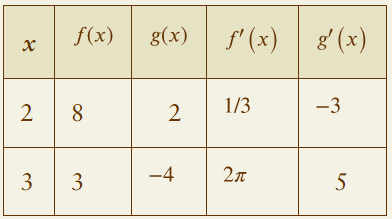
Suppose that functions f and g and their derivatives with respect to x have the following values at x = 2 and x = 3.


<IMAGE>


Find the derivatives with respect to x of the following combinations at the given value of x.


g. 1 / g²(x), x = 3

Verified step by step guidance
1
Step 1: Recall the derivative rule for the reciprocal of a function. If h(x) = 1 / g²(x), then h'(x) can be found using the chain rule and the power rule. Specifically, h'(x) = -2 * g(x)^(-3) * g'(x).
Step 2: Substitute the given value of x = 3 into the formula. From the table, g(x) = -4 and g'(x) = 5 at x = 3.
Step 3: Replace g(x) and g'(x) in the derivative formula. This gives h'(x) = -2 * (-4)^(-3) * 5.
Step 4: Simplify the expression step by step. First, calculate (-4)^(-3), which is the reciprocal of (-4)^3. Then multiply by -2 and g'(x).
Step 5: The simplified expression will give the derivative h'(x) at x = 3. Ensure all calculations are consistent with the rules of exponents and multiplication.

Verified video answer for a similar problem:

This video solution was recommended by our tutors as helpful for the problem above.
Video duration:
2m
Was this helpful?

Key Concepts

Here are the essential concepts you must grasp in order to answer the question correctly.

Chain Rule

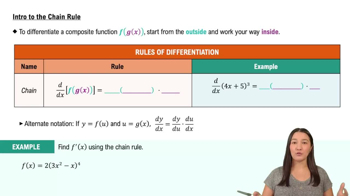
The chain rule is a fundamental differentiation technique used when dealing with composite functions. It states that the derivative of a composite function f(g(x)) is f'(g(x)) * g'(x). In this problem, the chain rule helps differentiate expressions involving powers of functions, such as g²(x), by considering the derivative of the outer function and multiplying it by the derivative of the inner function.
Recommended video:
05:02
Intro to the Chain Rule

Power Rule

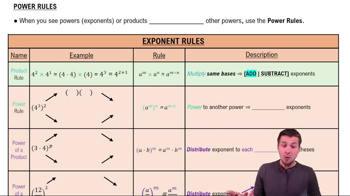
The power rule is a basic differentiation rule that states if f(x) = x^n, then f'(x) = n*x^(n-1). This rule is essential for finding the derivative of functions raised to a power, such as g²(x). In the context of the problem, it helps simplify the differentiation process by providing a straightforward method to handle powers of functions.
Recommended video:

Quotient Rule

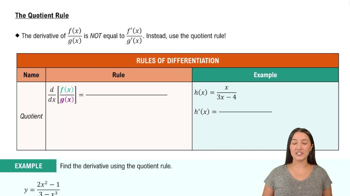
The quotient rule is used to differentiate functions that are ratios of two other functions. It states that if h(x) = f(x)/g(x), then h'(x) = (f'(x)g(x) - f(x)g'(x))/g²(x). In this problem, the quotient rule is applied to find the derivative of 1/g²(x), which involves differentiating a function in the form of a reciprocal, requiring careful application of the rule to ensure accuracy.
Recommended video:
06:43
The Quotient Rule
Related Practice
Textbook Question

Suppose that the functions f and g and their derivatives with respect to x have the following values at x = 0 and x = 1.


" style="max-width: 100%; white-space-collapse: preserve;" width="250">


Find the derivatives with respect to x of the following combinations at the given value of x.


f. (x¹¹ + f(x))⁻², x = 1

Textbook Question

Suppose that the functions f and g and their derivatives with respect to x have the following values at x = 0 and x = 1.


" style="max-width: 100%; white-space-collapse: preserve;" width="250">


Find the derivatives with respect to x of the following combinations at the given value of x.


g. f(x + g(x)), x = 0

Textbook Question

Slopes and Tangent Lines


In Exercises 13–16, differentiate the functions and find the slope of the tangent line at the given value of the independent variable.


f(x) = x + 9/x, x = −3

Textbook Question

Finding Derivative Functions and Values 


Using the definition, calculate the derivatives of the functions in Exercises 1–6. Then find the values of the derivatives as specified.


p(θ) = √3θ; p′(1), p′(3), p′(2/3)

Textbook Question

Suppose that functions f and g and their derivatives with respect to x have the following values at x = 2 and x = 3.


" style="max-width: 100%; white-space-collapse: preserve;" width="250">


Find the derivatives with respect to x of the following combinations at the given value of x.


h. √(f²(x) + g²(x)), x = 2

Textbook Question

Suppose that functions ƒ(x) and g(x) and their first derivatives have the following values at x = 0 and x = 1.


x ƒ(x) g(x) ƒ'(x) g'(x)

0 1 1 -3 1/2

1 3 5 1/2 -4


Find the first derivatives of the following combinations at the given value of x.


g. ƒ(x + g(x)), x = 0