
Ch. 3 - Derivatives
Hass - Thomas' Calculus 15th Edition
Hass15th EditionThomas' CalculusISBN: 9780137616077Not the one you use?Change textbook
Chapter 3, Problem 3.57g

Suppose that functions ƒ(x) and g(x) and their first derivatives have the following values at x = 0 and x = 1.


x ƒ(x) g(x) ƒ'(x) g'(x)
0 1 1 -3 1/2
1 3 5 1/2 -4


Find the first derivatives of the following combinations at the given value of x.


g. ƒ(x + g(x)), x = 0

Verified step by step guidance
1
To find the derivative of the composite function ƒ(x + g(x)), we will use the chain rule. The chain rule states that if you have a composite function h(x) = ƒ(u(x)), then the derivative h'(x) is ƒ'(u(x)) * u'(x).
In this problem, the outer function is ƒ and the inner function is u(x) = x + g(x). Therefore, we need to find the derivative of the inner function u(x) first.
The derivative of u(x) = x + g(x) is u'(x) = 1 + g'(x).
Now, apply the chain rule: the derivative of ƒ(x + g(x)) is ƒ'(x + g(x)) * (1 + g'(x)).
Evaluate this expression at x = 0 using the given values: ƒ'(x + g(x)) at x = 0 is ƒ'(0 + g(0)) = ƒ'(1), and 1 + g'(0) is 1 + 1/2. Use these values to find the derivative at x = 0.

Verified video answer for a similar problem:

This video solution was recommended by our tutors as helpful for the problem above.
Video duration:
3m
Was this helpful?

Key Concepts

Here are the essential concepts you must grasp in order to answer the question correctly.

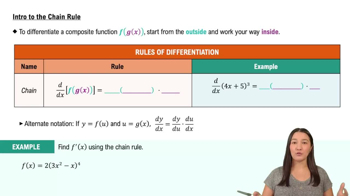
Chain Rule

The Chain Rule is a fundamental principle in calculus used to differentiate composite functions. It states that if you have a function that is composed of two functions, say f(g(x)), the derivative is found by multiplying the derivative of the outer function evaluated at the inner function by the derivative of the inner function. This rule is essential for solving problems involving functions of functions, such as g.ƒ(x + g(x)).
Recommended video:
05:02
Intro to the Chain Rule

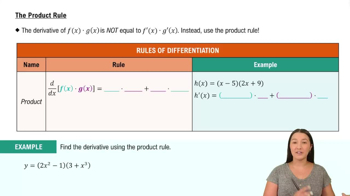
Product Rule

The Product Rule is another important differentiation rule that applies when differentiating the product of two functions. It states that if you have two functions u(x) and v(x), the derivative of their product u(x)v(x) is given by u'(x)v(x) + u(x)v'(x). This concept is crucial when dealing with expressions that involve products of functions, especially when evaluating derivatives at specific points.
Recommended video:
05:18
The Product Rule

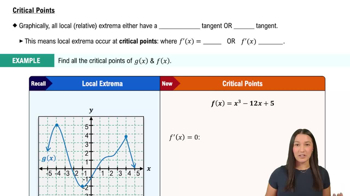
Evaluating Derivatives at Specific Points

Evaluating derivatives at specific points involves substituting a particular value of x into the derivative function to find the slope of the tangent line at that point. This process is vital for understanding the behavior of functions at specific locations, such as determining the rate of change of g.ƒ(x + g(x)) at x = 0. It requires knowledge of both the function and its derivative values at the given points.
Recommended video:
04:50
Critical Points
Related Practice
Textbook Question

Suppose that functions f and g and their derivatives with respect to x have the following values at x = 2 and x = 3.


" style="max-width: 100%; white-space-collapse: preserve;" width="250">


Find the derivatives with respect to x of the following combinations at the given value of x.


g. 1 / g²(x), x = 3

Textbook Question

Suppose that functions f and g and their derivatives with respect to x have the following values at x = 2 and x = 3.


" style="" width="250">


Find the derivatives with respect to x of the following combinations at the given value of x.


f. √f(x), x = 2

Textbook Question

Suppose that the functions f and g and their derivatives with respect to x have the following values at x = 0 and x = 1.


" style="max-width: 100%; white-space-collapse: preserve;" width="250">


Find the derivatives with respect to x of the following combinations at the given value of x.


f. (x¹¹ + f(x))⁻², x = 1

Textbook Question

Analyzing Motion Using Graphs


[Technology Exercise] Exercises 31–34 give the position function s = f(t) of an object moving along the s-axis as a function of time t. Graph f together with the velocity function v(t) = ds/dt = f'(t) and the acceleration function a(t) = d²s/dt² = f''(t). Comment on the object’s behavior in relation to the signs and values of v and a. Include in your commentary such topics as the following:


f. When is it farthest from the axis origin?


s = t³ - 6t² + 7t, 0 ≤ t ≤ 4

Textbook Question

Suppose that the functions f and g and their derivatives with respect to x have the following values at x = 0 and x = 1.


" style="max-width: 100%; white-space-collapse: preserve;" width="250">


Find the derivatives with respect to x of the following combinations at the given value of x.


g. f(x + g(x)), x = 0

Textbook Question

Suppose that functions f and g and their derivatives with respect to x have the following values at x = 2 and x = 3.


" style="max-width: 100%; white-space-collapse: preserve;" width="250">


Find the derivatives with respect to x of the following combinations at the given value of x.


h. √(f²(x) + g²(x)), x = 2