
Ch. 3 - Derivatives
Hass - Thomas' Calculus 15th Edition
Hass15th EditionThomas' CalculusISBN: 9780137616077Not the one you use?Change textbook
Chapter 3, Problem 3.6.76f

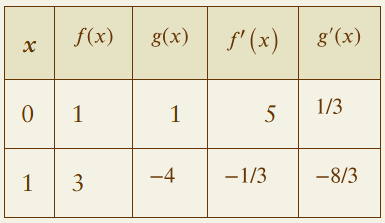
Suppose that the functions f and g and their derivatives with respect to x have the following values at x = 0 and x = 1.


<IMAGE>


Find the derivatives with respect to x of the following combinations at the given value of x.


f. (x¹¹ + f(x))⁻², x = 1

Verified step by step guidance
1
Step 1: Recognize that the given function is (x¹¹ + f(x))⁻². To find its derivative with respect to x, we will use the chain rule and the power rule.
Step 2: Let u = x¹¹ + f(x). Then the function becomes u⁻². The derivative of u⁻² with respect to u is -2u⁻³. By the chain rule, multiply this by the derivative of u with respect to x.
Step 3: Compute the derivative of u = x¹¹ + f(x). The derivative of x¹¹ is 11x¹⁰, and the derivative of f(x) is f'(x). So, du/dx = 11x¹⁰ + f'(x).
Step 4: Substitute u = x¹¹ + f(x) and du/dx = 11x¹⁰ + f'(x) into the chain rule result. The derivative of the function becomes -2(x¹¹ + f(x))⁻³ * (11x¹⁰ + f'(x)).
Step 5: Evaluate the derivative at x = 1. From the table, f(1) = 3 and f'(1) = -1/3. Substitute these values along with x = 1 into the expression for the derivative to simplify further.

Verified video answer for a similar problem:

This video solution was recommended by our tutors as helpful for the problem above.
Video duration:
5m
Was this helpful?

Key Concepts

Here are the essential concepts you must grasp in order to answer the question correctly.

Chain Rule

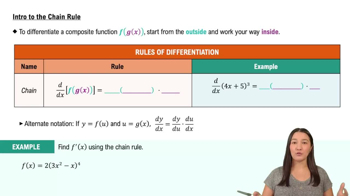
The chain rule is a fundamental technique in calculus used to differentiate composite functions. If you have a function h(x) = f(g(x)), the derivative h'(x) is found by multiplying the derivative of the outer function f at g(x) by the derivative of the inner function g at x. This rule is essential for differentiating expressions like (x¹¹ + f(x))⁻², where the outer function is raised to a power.
Recommended video:
05:02
Intro to the Chain Rule

Power Rule

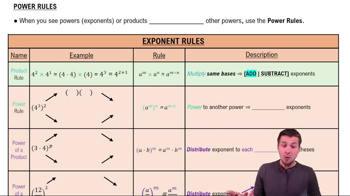
The power rule is a basic derivative rule used to find the derivative of functions of the form x^n, where n is a real number. According to the power rule, the derivative of x^n is n*x^(n-1). This rule is crucial when differentiating terms like x¹¹ in the given expression, as it allows us to handle polynomial components efficiently.
Recommended video:

Derivative of Inverse Functions

When differentiating an inverse function, such as (u(x))⁻², where u(x) = x¹¹ + f(x), the derivative involves applying the chain rule and the power rule. The derivative of u(x)⁻² is -2 * u(x)⁻³ * u'(x), where u'(x) is the derivative of the inner function. This concept is vital for solving the problem, as it combines multiple differentiation techniques.
Recommended video:
06:35
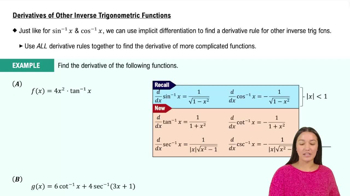
Derivatives of Other Inverse Trigonometric Functions
Related Practice
Textbook Question

Analyzing Motion Using Graphs


[Technology Exercise] Exercises 31–34 give the position function s = f(t) of an object moving along the s-axis as a function of time t. Graph f together with the velocity function v(t) = ds/dt = f'(t) and the acceleration function a(t) = d²s/dt² = f''(t). Comment on the object’s behavior in relation to the signs and values of v and a. Include in your commentary such topics as the following:


e. When is it moving fastest (highest speed)? Slowest?


s = 4 - 7t + 6t² - t³, 0 ≤ t ≤ 4

Textbook Question

Suppose that functions f and g and their derivatives with respect to x have the following values at x = 2 and x = 3.


" style="max-width: 100%; white-space-collapse: preserve;" width="250">


Find the derivatives with respect to x of the following combinations at the given value of x.


g. 1 / g²(x), x = 3

Textbook Question

Suppose that functions f and g and their derivatives with respect to x have the following values at x = 2 and x = 3.


" style="" width="250">


Find the derivatives with respect to x of the following combinations at the given value of x.


f. √f(x), x = 2

Textbook Question

Analyzing Motion Using Graphs


[Technology Exercise] Exercises 31–34 give the position function s = f(t) of an object moving along the s-axis as a function of time t. Graph f together with the velocity function v(t) = ds/dt = f'(t) and the acceleration function a(t) = d²s/dt² = f''(t). Comment on the object’s behavior in relation to the signs and values of v and a. Include in your commentary such topics as the following:


f. When is it farthest from the axis origin?


s = t³ - 6t² + 7t, 0 ≤ t ≤ 4

Textbook Question

Suppose that the functions f and g and their derivatives with respect to x have the following values at x = 0 and x = 1.


" style="max-width: 100%; white-space-collapse: preserve;" width="250">


Find the derivatives with respect to x of the following combinations at the given value of x.


g. f(x + g(x)), x = 0

Textbook Question

Suppose that functions ƒ(x) and g(x) and their first derivatives have the following values at x = 0 and x = 1.


x ƒ(x) g(x) ƒ'(x) g'(x)

0 1 1 -3 1/2

1 3 5 1/2 -4


Find the first derivatives of the following combinations at the given value of x.


g. ƒ(x + g(x)), x = 0