
Ch. 3 - Derivatives
Hass - Thomas' Calculus 15th Edition
Hass15th EditionThomas' CalculusISBN: 9780137616077Not the one you use?Change textbook
Chapter 3, Problem 3.6.75h

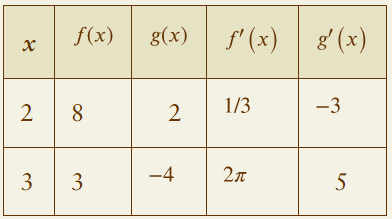
Suppose that functions f and g and their derivatives with respect to x have the following values at x = 2 and x = 3.


<IMAGE>


Find the derivatives with respect to x of the following combinations at the given value of x.


h. √(f²(x) + g²(x)), x = 2

Verified step by step guidance
1
Step 1: Recognize that the function h(x) = √(f²(x) + g²(x)) involves a composition of functions. To find h'(x), use the chain rule and the derivative of the square root function.
Step 2: The derivative of √(u) with respect to u is (1 / (2√u)). Here, u = f²(x) + g²(x). Apply this formula to h(x).
Step 3: Differentiate the inner function f²(x) + g²(x) with respect to x. Use the chain rule for each term: the derivative of f²(x) is 2f(x)f'(x), and the derivative of g²(x) is 2g(x)g'(x).
Step 4: Combine the results from Steps 2 and 3. Substitute the derivative of the inner function into the formula for h'(x): h'(x) = (1 / (2√(f²(x) + g²(x)))) * (2f(x)f'(x) + 2g(x)g'(x)).
Step 5: Evaluate h'(x) at x = 2 using the values from the table: f(2) = 8, g(2) = 2, f'(2) = 1/3, and g'(2) = -3. Substitute these values into the formula derived in Step 4 to compute h'(2).

Verified video answer for a similar problem:

This video solution was recommended by our tutors as helpful for the problem above.
Video duration:
7m
Was this helpful?

Key Concepts

Here are the essential concepts you must grasp in order to answer the question correctly.

Chain Rule

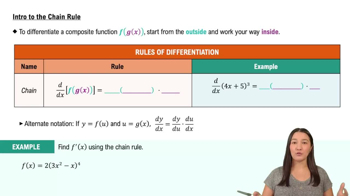
The chain rule is a fundamental differentiation technique used when dealing with composite functions. It states that the derivative of a composite function h(x) = f(g(x)) is h'(x) = f'(g(x)) * g'(x). In this problem, the chain rule helps differentiate the square root function, which is a composition of the inner function f²(x) + g²(x).
Recommended video:
05:02
Intro to the Chain Rule

Power Rule

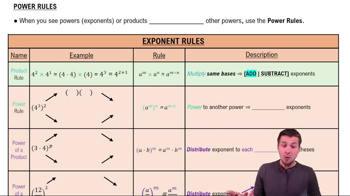
The power rule is used to differentiate functions of the form x^n, where n is a constant. It states that the derivative of x^n is n*x^(n-1). In this context, the power rule is applied to differentiate f²(x) and g²(x), which are parts of the expression under the square root. This helps in finding the derivative of the inner function.
Recommended video:

Sum Rule

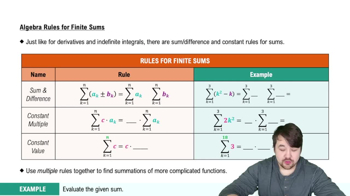
The sum rule in calculus states that the derivative of a sum of functions is the sum of their derivatives. For the expression f²(x) + g²(x), the sum rule allows us to differentiate each term separately and then add the results. This is crucial for simplifying the derivative of the inner function before applying the chain rule.
Recommended video:
05:44
Algebra Rules for Finite Sums
Related Practice
Textbook Question

Suppose that functions f and g and their derivatives with respect to x have the following values at x = 2 and x = 3.


" style="max-width: 100%; white-space-collapse: preserve;" width="250">


Find the derivatives with respect to x of the following combinations at the given value of x.


g. 1 / g²(x), x = 3

Textbook Question

Suppose that the functions f and g and their derivatives with respect to x have the following values at x = 0 and x = 1.


" style="max-width: 100%; white-space-collapse: preserve;" width="250">


Find the derivatives with respect to x of the following combinations at the given value of x.


g. f(x + g(x)), x = 0

Textbook Question

Slopes and Tangent Lines


In Exercises 13–16, differentiate the functions and find the slope of the tangent line at the given value of the independent variable.


y = (x + 3)/(1 – x), x = −2

Textbook Question

Slopes and Tangent Lines


In Exercises 13–16, differentiate the functions and find the slope of the tangent line at the given value of the independent variable.


f(x) = x + 9/x, x = −3

Textbook Question

Finding Derivative Functions and Values 


Using the definition, calculate the derivatives of the functions in Exercises 1–6. Then find the values of the derivatives as specified.


p(θ) = √3θ; p′(1), p′(3), p′(2/3)

Textbook Question

Suppose that functions ƒ(x) and g(x) and their first derivatives have the following values at x = 0 and x = 1.


x ƒ(x) g(x) ƒ'(x) g'(x)

0 1 1 -3 1/2

1 3 5 1/2 -4


Find the first derivatives of the following combinations at the given value of x.


g. ƒ(x + g(x)), x = 0