
Ch. 3 - Derivatives
Hass - Thomas' Calculus 15th Edition
Hass15th EditionThomas' CalculusISBN: 9780137616077Not the one you use?Change textbook
Chapter 3, Problem 13

Slopes and Tangent Lines


In Exercises 13–16, differentiate the functions and find the slope of the tangent line at the given value of the independent variable.


f(x) = x + 9/x, x = −3

Verified step by step guidance
1
First, identify the function you need to differentiate: \( f(x) = x + \frac{9}{x} \). This function is composed of two terms: a linear term \( x \) and a rational term \( \frac{9}{x} \).
Differentiate each term separately. The derivative of \( x \) with respect to \( x \) is 1. For the term \( \frac{9}{x} \), rewrite it as \( 9x^{-1} \) and use the power rule to differentiate, which gives \( -9x^{-2} \).
Combine the derivatives of the individual terms to find the derivative of the entire function: \( f'(x) = 1 - \frac{9}{x^2} \).
Substitute the given value of the independent variable \( x = -3 \) into the derivative to find the slope of the tangent line at that point: \( f'(-3) = 1 - \frac{9}{(-3)^2} \).
Simplify the expression to find the slope of the tangent line at \( x = -3 \). This involves calculating \( (-3)^2 \) and simplifying the fraction \( \frac{9}{9} \).

Verified video answer for a similar problem:

This video solution was recommended by our tutors as helpful for the problem above.
Video duration:
8m
Was this helpful?

Key Concepts

Here are the essential concepts you must grasp in order to answer the question correctly.

Differentiation

Differentiation is the process of finding the derivative of a function, which represents the rate of change of the function with respect to its independent variable. For the function f(x) = x + 9/x, differentiation involves applying the power rule and the quotient rule to find f'(x), the derivative of f(x).
Recommended video:
05:53
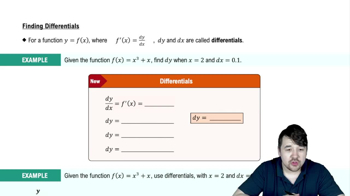
Finding Differentials

Slope of the Tangent Line

The slope of the tangent line to a curve at a given point is the value of the derivative at that point. It represents the instantaneous rate of change of the function. For f(x) = x + 9/x at x = -3, the slope is found by evaluating the derivative f'(x) at x = -3.
Recommended video:
05:13
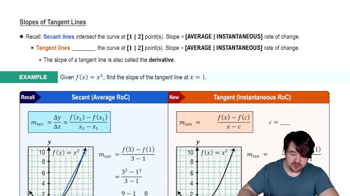
Slopes of Tangent Lines

Evaluating Derivatives at a Point

Once the derivative of a function is determined, it can be evaluated at a specific point to find the slope of the tangent line at that point. This involves substituting the given value of the independent variable into the derivative. For f(x) = x + 9/x, substitute x = -3 into f'(x) to find the slope.
Recommended video:
04:50
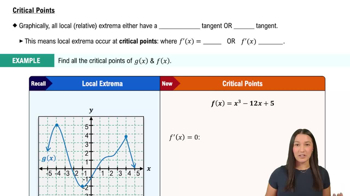
Critical Points
Related Practice
Textbook Question

Suppose that functions f and g and their derivatives with respect to x have the following values at x = 2 and x = 3.


" style="max-width: 100%; white-space-collapse: preserve;" width="250">


Find the derivatives with respect to x of the following combinations at the given value of x.


g. 1 / g²(x), x = 3

Textbook Question

Understanding Motion from Graphs


Launching a Rocket When a model rocket is launched, the propellant burns for a few seconds, accelerating the rocket upward. After burnout, the rocket coasts upward for a while and then begins to fall. A small explosive charge pops out a parachute shortly after the rocket starts down. The parachute slows the rocket to keep it from breaking when it lands.


The figure here shows velocity data from the flight of the model rocket. Use the data to answer the following.


b. For how many seconds did the engine burn?


Textbook Question

Understanding Motion from Graphs


Launching a Rocket When a model rocket is launched, the propellant burns for a few seconds, accelerating the rocket upward. After burnout, the rocket coasts upward for a while and then begins to fall. A small explosive charge pops out a parachute shortly after the rocket starts down. The parachute slows the rocket to keep it from breaking when it lands.


The figure here shows velocity data from the flight of the model rocket. Use the data to answer the following.


a. How fast was the rocket climbing when the engine stopped?


Textbook Question

Slopes and Tangent Lines


In Exercises 13–16, differentiate the functions and find the slope of the tangent line at the given value of the independent variable.


y = (x + 3)/(1 – x), x = −2

Textbook Question

Finding Derivative Functions and Values 


Using the definition, calculate the derivatives of the functions in Exercises 1–6. Then find the values of the derivatives as specified.


p(θ) = √3θ; p′(1), p′(3), p′(2/3)

Textbook Question

Suppose that functions f and g and their derivatives with respect to x have the following values at x = 2 and x = 3.


" style="max-width: 100%; white-space-collapse: preserve;" width="250">


Find the derivatives with respect to x of the following combinations at the given value of x.


h. √(f²(x) + g²(x)), x = 2