
Ch. 9 - Differential Equations
Briggs - Calculus: Early Transcendentals 3rd Edition
Briggs3rd EditionCalculus: Early TranscendentalsISBN: 9780136847243Not the one you use?Change textbook
Chapter 9, Problem 9.5.6

What are the assumptions underlying the predator-prey model discussed in this section?

Verified step by step guidance
1
Understand that the predator-prey model, often represented by the Lotka-Volterra equations, is a system of differential equations modeling the interaction between two species: predators and their prey.
Identify the key assumptions about the prey population: it grows exponentially in the absence of predators, meaning unlimited resources and no other limiting factors affect its growth.
Recognize the assumptions about the predator population: it declines exponentially in the absence of prey, implying that predators rely solely on the prey for food and survival.
Note the interaction assumptions: the rate at which predators consume prey is proportional to the product of their populations, indicating encounters between predators and prey happen randomly and frequently.
Acknowledge that the model assumes no environmental complexity such as migration, age structure, or other species interactions, and that the environment is constant over time.

Verified video answer for a similar problem:

This video solution was recommended by our tutors as helpful for the problem above.
Video duration:
4m
Was this helpful?

Key Concepts

Here are the essential concepts you must grasp in order to answer the question correctly.

Lotka-Volterra Predator-Prey Model

This mathematical model describes the interaction between predator and prey populations using differential equations. It assumes that prey population grows exponentially in the absence of predators, while predators depend solely on prey for food, affecting their growth rate.
Recommended video:
09:29
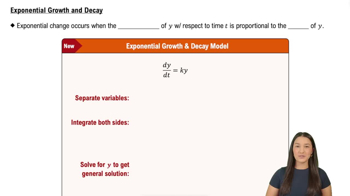
Exponential Growth & Decay

Assumptions of Population Dynamics

The model assumes constant environmental conditions, no immigration or emigration, and that the populations are homogeneous and well-mixed. It also presumes that the predator's consumption rate is proportional to the encounter rate with prey.
Recommended video:
03:55
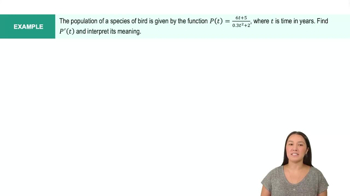
The Quotient Rule Example 5

Closed System and Interaction Rates

The predator-prey model assumes a closed ecosystem with no external influences. Interaction rates, such as predation and reproduction, are constant and directly proportional to the sizes of the respective populations, simplifying real-world complexities.
Recommended video:
04:16
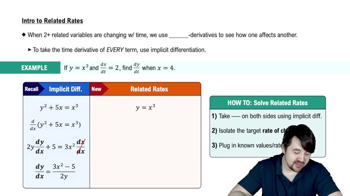
Intro To Related Rates