
Textbook Question
A family of exponential functions
b. Verify that the arc length of the curve y=f(x) on the interval [0, ln 2] is A(2^a-1) - 1/4a²A (2^-a - 1).

 Verified step by step guidance
 05:09
05:09
 05:03
05:03 06:15
06:15A family of exponential functions
b. Verify that the arc length of the curve y=f(x) on the interval [0, ln 2] is A(2^a-1) - 1/4a²A (2^-a - 1).
Explain how the growth rate function determines the solution of a population model.
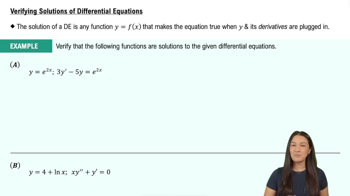
7–16. Verifying general solutions Verify that the given function is a solution of the differential equation that follows it. Assume C, C1, C2 and C3 are arbitrary constants.
u(t) = C₁eᵗ + C₂teᵗ; u''(t) - 2u'(t) + u(t) = 0
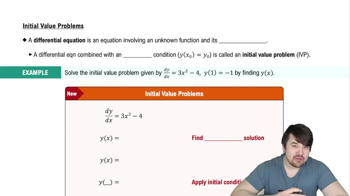
33–38. {Use of Tech} Solutions in implicit form Solve the following initial value problems and leave the solution in implicit form. Use graphing software to plot the solution. If the implicit solution describes more than one function, be sure to indicate which function corresponds to the solution of the initial value problem.
y'(t) = 2t²/(y² − 1), y(0) = 0
7–16. Verifying general solutions Verify that the given function is a solution of the differential equation that follows it. Assume C, C1, C2 and C3 are arbitrary constants.
y(t) = C₁ sin4t + C₂ cos4t; y''(t) + 16y(t) = 0
What are the assumptions underlying the predator-prey model discussed in this section?