
Ch. 9 - Differential Equations
Briggs - Calculus: Early Transcendentals 3rd Edition
Briggs3rd EditionCalculus: Early TranscendentalsISBN: 9780136847243Not the one you use?Change textbook
Chapter 9, Problem 9.1.9

7–16. Verifying general solutions Verify that the given function is a solution of the differential equation that follows it. Assume C, C1, C2 and C3 are arbitrary constants.
y(t) = C₁ sin4t + C₂ cos4t; y''(t) + 16y(t) = 0

Verified step by step guidance
1
Identify the given function and the differential equation: the function is \(y(t) = C_1 \sin 4t + C_2 \cos 4t\), and the differential equation is \(y''(t) + 16y(t) = 0\).
Compute the first derivative \(y'(t)\) of the function using the chain rule: differentiate each term with respect to \(t\).
Compute the second derivative \(y''(t)\) by differentiating \(y'(t)\) again with respect to \(t\).
Substitute \(y(t)\) and \(y''(t)\) into the differential equation \(y''(t) + 16y(t)\) and simplify the expression.
Check if the simplified expression equals zero for all \(t\), which verifies that the given function is indeed a solution to the differential equation.

Verified video answer for a similar problem:

This video solution was recommended by our tutors as helpful for the problem above.
Video duration:
3m
Was this helpful?

Key Concepts

Here are the essential concepts you must grasp in order to answer the question correctly.

General Solution of a Differential Equation

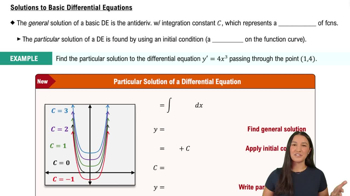
The general solution of a differential equation includes all possible solutions and typically contains arbitrary constants. It represents the complete set of functions that satisfy the equation, allowing for initial conditions to specify a unique solution.
Recommended video:
04:00
Solutions to Basic Differential Equations

Verification by Substitution

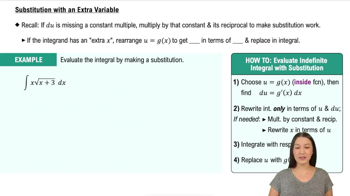
To verify a solution, substitute the given function and its derivatives into the differential equation. If the equation holds true for all values in the domain, the function is a valid solution.
Recommended video:
04:27
Substitution With an Extra Variable

Second Derivative and Trigonometric Functions

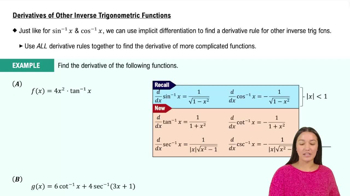
Calculating the second derivative of trigonometric functions like sine and cosine involves applying differentiation rules twice. For example, the second derivative of sin(kt) is -k² sin(kt), which is essential in solving and verifying solutions of differential equations involving harmonic motion.
Recommended video:
06:35
Derivatives of Other Inverse Trigonometric Functions