
Ch. 9 - Differential Equations
Briggs - Calculus: Early Transcendentals 3rd Edition
Briggs3rd EditionCalculus: Early TranscendentalsISBN: 9780136847243Not the one you use?Change textbook
Chapter 9, Problem 6.5.41b

A family of exponential functions


b. Verify that the arc length of the curve y=f(x) on the interval [0, ln 2] is A(2^a-1) - 1/4a²A (2^-a - 1).

Verified step by step guidance
1
Identify the given function and the interval. The function is of the form \(y = f(x)\), where \(f(x)\) is an exponential function involving a parameter \(a\). The interval is \([0, \ln 2]\).
Recall the formula for the arc length \(L\) of a curve \(y = f(x)\) on the interval \([a, b]\): \[L = \int_a^b \sqrt{1 + \left(\frac{dy}{dx}\right)^2} \, dx\]
Compute the derivative \(\frac{dy}{dx}\) of the function \(y = f(x)\). Since \(f(x)\) is exponential, use the chain rule carefully to express \(\frac{dy}{dx}\) in terms of \(x\) and \(a\).
Substitute \(\frac{dy}{dx}\) into the arc length formula and simplify the expression inside the square root. This may involve algebraic manipulation and properties of exponents to rewrite the integrand in a more manageable form.
Evaluate the definite integral from \(0\) to \(\ln 2\). Use substitution if necessary to integrate the expression, and simplify the result to verify that it matches the given formula: \[A(2^a - 1) - \frac{1}{4a^2} A (2^{-a} - 1)\]

Verified video answer for a similar problem:

This video solution was recommended by our tutors as helpful for the problem above.
Video duration:
4m
Was this helpful?

Key Concepts

Here are the essential concepts you must grasp in order to answer the question correctly.

Arc Length Formula

The arc length of a curve y = f(x) from x = a to x = b is given by the integral of the square root of 1 plus the square of the derivative, ∫_a^b √(1 + (f'(x))²) dx. This formula measures the distance along the curve between two points.
Recommended video:
06:29
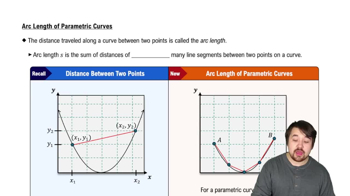
Arc Length of Parametric Curves

Derivative of Exponential Functions

For exponential functions of the form f(x) = A * b^(a x), the derivative involves the chain rule and properties of exponentials: f'(x) = A * a * ln(b) * b^(a x). Understanding this derivative is essential to compute the integrand in the arc length formula.
Recommended video:
04:50
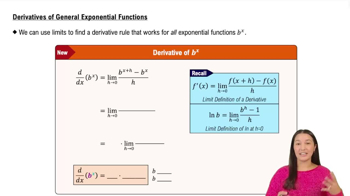
Derivatives of General Exponential Functions

Integration Techniques for Exponentials

Evaluating the arc length integral often requires integrating expressions involving exponentials and square roots. Techniques include substitution and recognizing patterns to simplify the integral into a solvable form, enabling verification of the given arc length expression.
Recommended video:
05:11
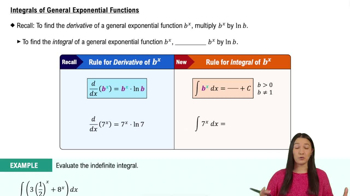
Integrals of General Exponential Functions