
Ch. 9 - Differential Equations
Briggs - Calculus: Early Transcendentals 3rd Edition
Briggs3rd EditionCalculus: Early TranscendentalsISBN: 9780136847243Not the one you use?Change textbook
Chapter 9, Problem 9.1.12

7–16. Verifying general solutions Verify that the given function is a solution of the differential equation that follows it. Assume C, C1, C2 and C3 are arbitrary constants.
u(t) = C₁eᵗ + C₂teᵗ; u''(t) - 2u'(t) + u(t) = 0

Verified step by step guidance
1
Identify the given function: \(u(t) = C_1 e^t + C_2 t e^t\), where \(C_1\) and \(C_2\) are arbitrary constants.
Compute the first derivative \(u'(t)\) using the product rule for the term \(C_2 t e^t\): \(u'(t) = \frac{d}{dt}(C_1 e^t) + \frac{d}{dt}(C_2 t e^t) = C_1 e^t + C_2 \left( e^t + t e^t \right)\).
Simplify the first derivative: \(u'(t) = C_1 e^t + C_2 e^t + C_2 t e^t = (C_1 + C_2) e^t + C_2 t e^t\).
Compute the second derivative \(u''(t)\) by differentiating \(u'(t)\) again, applying the product rule to the \(C_2 t e^t\) term: \(u''(t) = \frac{d}{dt} \left( (C_1 + C_2) e^t + C_2 t e^t \right) = (C_1 + C_2) e^t + C_2 \left( e^t + t e^t \right)\).
Substitute \(u(t)\), \(u'(t)\), and \(u''(t)\) into the differential equation \(u''(t) - 2 u'(t) + u(t) = 0\) and simplify the expression. If the left-hand side simplifies to zero for all \(t\), then \(u(t)\) is a solution to the differential equation.

Verified video answer for a similar problem:

This video solution was recommended by our tutors as helpful for the problem above.
Video duration:
11m
Was this helpful?

Key Concepts

Here are the essential concepts you must grasp in order to answer the question correctly.

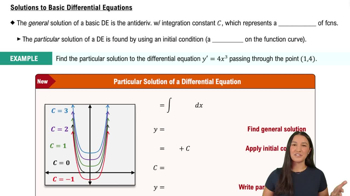
General Solution of a Differential Equation

The general solution of a differential equation includes all possible solutions and typically contains arbitrary constants. It represents the complete set of functions that satisfy the equation, allowing for initial conditions to specify a unique solution.
Recommended video:
04:00
Solutions to Basic Differential Equations

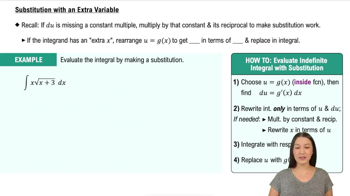
Verification by Substitution

To verify a solution, substitute the given function and its derivatives into the differential equation. If the equation holds true for all values in the domain, the function is a valid solution.
Recommended video:
04:27
Substitution With an Extra Variable

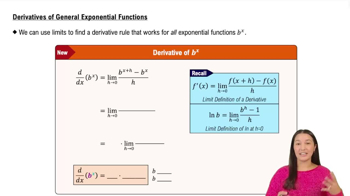
Derivatives of Exponential Functions

Understanding how to compute derivatives of functions involving exponentials and products, such as te^t, is essential. Use the product rule for derivatives when differentiating terms like C₂teᵗ.
Recommended video:
04:50
Derivatives of General Exponential Functions
Related Practice
Textbook Question

33–38. {Use of Tech} Solutions in implicit form Solve the following initial value problems and leave the solution in implicit form. Use graphing software to plot the solution. If the implicit solution describes more than one function, be sure to indicate which function corresponds to the solution of the initial value problem.

z(x) = (z² + 4)/(x² + 16), z(4) = 2

1
views
Textbook Question

Explain how the growth rate function determines the solution of a population model.

Textbook Question

33–38. {Use of Tech} Solutions in implicit form Solve the following initial value problems and leave the solution in implicit form. Use graphing software to plot the solution. If the implicit solution describes more than one function, be sure to indicate which function corresponds to the solution of the initial value problem.

y'(t) = 2t²/(y² − 1), y(0) = 0

1
views
Textbook Question

21–24. Logistic equations Consider the following logistic equations. In each case, sketch the direction field, draw the solution curve for each initial condition, and find the equilibrium solutions. A detailed direction field is not needed. Assume t ≥ 0 and tP ≥ 0.

P′(t) = 0.05P − 0.001P²; P(0) = 10, P(0) = 40, P(0) = 80

Textbook Question

What are the assumptions underlying the predator-prey model discussed in this section?

1
views
Textbook Question

12–16. Sketching direction fields Use the window [-2, 2] x [-2, 2] to sketch a direction field for the following equations. Then sketch the solution curve that corresponds to the given initial condition. A detailed direction field is not needed.

y'(t) = 4−y, y(0) = −1