Ch. 6 - Applications of Integration
Briggs - Calculus: Early Transcendentals 3rd Edition
Briggs3rd EditionCalculus: Early TranscendentalsISBN: 9780136847243Not the one you use?Change textbook
Chapter 6, Problem 6.3.62

Use calculus to find the volume of a tetrahedron (pyramid with four triangular faces), all of whose edges have length 4.

Verified step by step guidance
1
Step 1: Begin by understanding the geometry of the tetrahedron. A tetrahedron is a three-dimensional shape with four triangular faces. Since all edges are of equal length (4 units), this is a regular tetrahedron. The volume of a tetrahedron can be calculated using calculus by integrating over its region in three-dimensional space.
Step 2: Place the tetrahedron in a coordinate system. Assign vertices to the tetrahedron: A(0, 0, 0), B(4, 0, 0), C(2, √12, 0), and D(2, √3, √11). These coordinates are derived based on the geometry of the regular tetrahedron and the edge length of 4.
Step 3: Write the equations of the planes that form the faces of the tetrahedron. For example, the plane containing vertices A, B, and C can be expressed as: z=0. Similarly, derive equations for the other three planes using the coordinates of their respective vertices.
Step 4: Set up the triple integral to calculate the volume. The limits of integration will be determined by the equations of the planes. The general form of the integral is: Vdxdydz, where V is the region enclosed by the tetrahedron.
Step 5: Evaluate the triple integral by integrating step-by-step. First, integrate with respect to z, then y, and finally x, using the limits defined by the planes. This will yield the volume of the tetrahedron.

Verified video answer for a similar problem:

This video solution was recommended by our tutors as helpful for the problem above.
Video duration:
7m
Was this helpful?

Key Concepts

Here are the essential concepts you must grasp in order to answer the question correctly.

Volume of a Tetrahedron

The volume of a tetrahedron can be calculated using the formula V = (1/3) * base area * height. For a regular tetrahedron, where all edges are equal, the base is an equilateral triangle, and the height can be derived using the Pythagorean theorem. Understanding how to derive these dimensions is crucial for calculating the volume.
Recommended video:
04:48
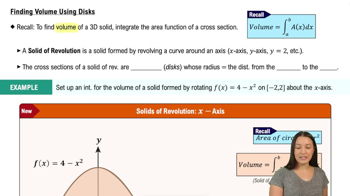
Finding Volume Using Disks

Pythagorean Theorem

The Pythagorean theorem states that in a right triangle, the square of the length of the hypotenuse is equal to the sum of the squares of the lengths of the other two sides. This theorem is essential for finding the height of the tetrahedron when given the edge length, as it allows us to relate the dimensions of the tetrahedron's triangular faces to its height.
Recommended video:
06:11
Fundamental Theorem of Calculus Part 1

Geometric Properties of Tetrahedrons

A tetrahedron has four triangular faces, six edges, and four vertices. In a regular tetrahedron, all edges are of equal length, which simplifies calculations. Understanding the geometric properties, such as how to calculate the area of the triangular faces and the relationships between the edges and height, is vital for solving volume problems.
Recommended video:
06:21
Properties of Functions