Ch. 6 - Applications of Integration
Briggs - Calculus: Early Transcendentals 3rd Edition
Briggs3rd EditionCalculus: Early TranscendentalsISBN: 9780136847243Not the one you use?Change textbook
Chapter 6, Problem 6.7.11

9–12. Consider the cylindrical tank in Example 4 that has a height of 10 m and a radius of 5 m. Recall that if the tank is full of water, then ∫₀¹⁰ 25 π ρg(15−y) dy equals the work required to pump all the water out of the tank, through an outflow pipe that is 15 m above the bottom of the tank. Revise this work integral for the following scenarios. (Do not evaluate the integrals.)


The work required to empty the tank through an outflow pipe at the top of the tank

Verified step by step guidance
1
Identify the physical setup: The tank is a cylinder with height 10 m and radius 5 m, filled with water. The density of water is \( \rho \), and gravitational acceleration is \( g \). The work done to pump water depends on the distance each water slice must be lifted to the outflow point.
Recall the original integral for pumping water to a pipe 15 m above the bottom: \( \int_0^{10} 25 \pi \rho g (15 - y) \, dy \), where \( y \) is the vertical coordinate from the bottom, and \( 25 \pi \) is the cross-sectional area (since radius = 5 m, area = \( \pi \times 5^2 = 25 \pi \)).
For the new scenario, the outflow pipe is at the top of the tank, which is 10 m above the bottom. Therefore, the distance each water slice at height \( y \) must be lifted is \( 10 - y \).
Set up the revised integral for work as \( W = \int_0^{10} 25 \pi \rho g (10 - y) \, dy \). This integral sums the work to lift each thin horizontal slice of water (with volume \( 25 \pi \, dy \)) from height \( y \) to the top at 10 m.
This integral represents the total work required to pump all the water out through the pipe at the top of the tank. No further evaluation is needed as per the problem instructions.

Verified video answer for a similar problem:

This video solution was recommended by our tutors as helpful for the problem above.
Video duration:
2m
Was this helpful?

Key Concepts

Here are the essential concepts you must grasp in order to answer the question correctly.

Work as an Integral in Fluid Mechanics

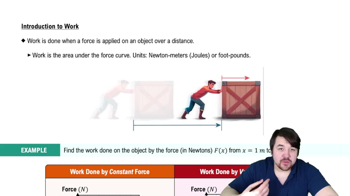
Work done to pump fluid is calculated by integrating the force needed to move each layer of fluid times the distance it must be moved. This involves setting up an integral where the integrand represents the weight of a thin slice of fluid multiplied by the vertical distance to the outflow point.
Recommended video:
06:22
Introduction To Work

Volume and Weight of a Cylindrical Slice

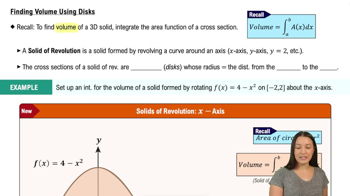
A thin horizontal slice of water in the tank has volume equal to the cross-sectional area times its thickness (dy). Multiplying this volume by the fluid density and gravitational acceleration gives the weight of the slice, which is essential for determining the force required to move it.
Recommended video:
04:48
Finding Volume Using Disks

Distance Function in Work Integral

The distance each slice of water must be lifted depends on its vertical position relative to the outflow pipe. Accurately expressing this distance as a function of the variable of integration (y) is crucial for setting up the correct integral for work.
Recommended video:
06:22
Introduction To Work