Ch. 6 - Applications of Integration
Briggs - Calculus: Early Transcendentals 3rd Edition
Briggs3rd EditionCalculus: Early TranscendentalsISBN: 9780136847243Not the one you use?Change textbook
Chapter 6, Problem 6.3.20

Let R be the region bounded by the following curves. Find the volume of the solid generated when R is revolved about the given axis.
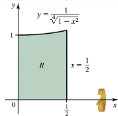
y=1 / 4√1 − x^2,y=0,x=0, and x=12; about the x-axis
Shaded region bounded by y = 1/4√(1−x²), y=0, x=0, and x=1/2, rotated about the x-axis.

Verified step by step guidance
1
Identify the region R bounded by the curves: \(y = \frac{1}{4} \sqrt{1 - x^2}\), \(y = 0\), \(x = 0\), and \(x = \frac{1}{2}\).
Since the region is revolved about the x-axis, use the disk method to find the volume. The volume of the solid is given by the integral \(V = \pi \int_a^b [f(x)]^2 \, dx\), where \(f(x)\) is the radius of the disk at position \(x\).
Here, the radius of each disk is the function \(y = \frac{1}{4} \sqrt{1 - x^2}\), so the volume integral becomes \(V = \pi \int_0^{\frac{1}{2}} \left( \frac{1}{4} \sqrt{1 - x^2} \right)^2 \, dx\).
Simplify the integrand inside the integral: \(\left( \frac{1}{4} \sqrt{1 - x^2} \right)^2 = \frac{1}{16} (1 - x^2)\), so the integral is \(V = \pi \int_0^{\frac{1}{2}} \frac{1}{16} (1 - x^2) \, dx\).
Evaluate the integral \(\int_0^{\frac{1}{2}} (1 - x^2) \, dx\) and multiply the result by \(\frac{\pi}{16}\) to find the volume of the solid.

Verified video answer for a similar problem:

This video solution was recommended by our tutors as helpful for the problem above.
Video duration:
3m
Was this helpful?

Key Concepts

Here are the essential concepts you must grasp in order to answer the question correctly.

Volume of Solids of Revolution

This concept involves finding the volume of a 3D solid formed by rotating a 2D region around an axis. The volume can be computed using methods like the disk/washer or shell method, depending on the axis of rotation and the shape of the region.
Recommended video:
04:48
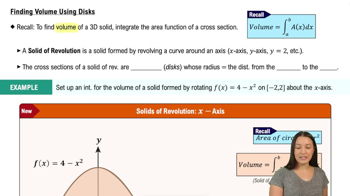
Finding Volume Using Disks

Disk Method

The disk method calculates volume by slicing the solid perpendicular to the axis of rotation into thin disks. Each disk's volume is approximated by π(radius)^2 × thickness, where the radius is the distance from the axis to the curve. Integrating these volumes over the interval gives the total volume.
Recommended video:
06:30
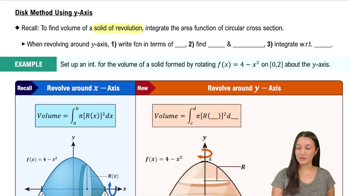
Disk Method Using y-Axis

Definite Integration with Function Boundaries

Definite integration is used to sum infinitely many infinitesimal volumes. The limits of integration correspond to the bounds of the region (here, x=0 to x=1/2). The integrand is derived from the function describing the curve, which in this case is y = (1/4)√(1−x²).
Recommended video:
05:43
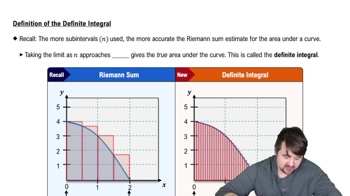
Definition of the Definite Integral