Find the area of the shaded regions in the following figures.
Ch. 6 - Applications of Integration
Briggs3rd EditionCalculus: Early TranscendentalsISBN: 9780136847243Not the one you use?Change textbook
Chapter 6, Problem 6.2.39
Find the area of the region described in the following exercises.
The region bounded by y=e^x, y=e^−2x, and x=ln 4
Verified step by step guidance1
Identify the curves and boundaries that enclose the region: the curves are \( y = e^{x} \), \( y = e^{-2x} \), and the vertical line \( x = \ln 4 \).
Find the points of intersection between the two curves \( y = e^{x} \) and \( y = e^{-2x} \) by setting them equal: \( e^{x} = e^{-2x} \). Solve for \( x \) to determine the left boundary of the region.
Determine which curve is on top and which is on the bottom between the intersection point and \( x = \ln 4 \) by comparing \( e^{x} \) and \( e^{-2x} \) in that interval.
Set up the integral for the area of the region as the integral from the left intersection point to \( x = \ln 4 \) of the difference between the top curve and the bottom curve: \[ \text{Area} = \int_{x=a}^{\ln 4} \left( e^{x} - e^{-2x} \right) \, dx \], where \( a \) is the intersection point found earlier.
Evaluate the integral by integrating each term separately: \( \int e^{x} \, dx \) and \( \int e^{-2x} \, dx \), then apply the limits of integration to find the area.

Verified video answer for a similar problem:
This video solution was recommended by our tutors as helpful for the problem above.
Video duration:
4mWas this helpful?
Key Concepts
Here are the essential concepts you must grasp in order to answer the question correctly.
Understanding the Region Bounded by Curves
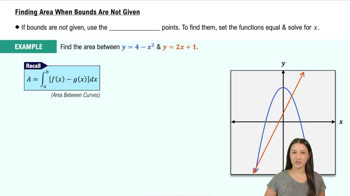
To find the area between curves, identify the region enclosed by the given functions and boundaries. This involves determining the points of intersection and the limits of integration, ensuring the correct curves are used as upper and lower bounds within the specified interval.
Recommended video:
Finding Area When Bounds Are Not Given
Definite Integration for Area Calculation
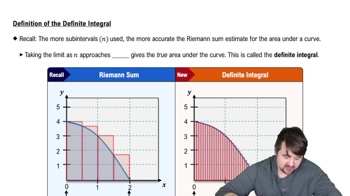
The area between two curves y = f(x) and y = g(x) over an interval [a, b] is found by integrating the difference f(x) - g(x) with respect to x. Definite integrals compute the exact area under the curve between the limits, accounting for the vertical distance between the functions.
Recommended video:
Definition of the Definite Integral
Properties of Exponential Functions
Exponential functions like y = e^x and y = e^{-2x} have distinct growth and decay behaviors. Understanding their shapes and intersections helps in setting up the integral correctly, especially when determining which function is on top or bottom within the interval.
Recommended video:
Properties of Functions
Related Practice
Textbook Question
1
views
Textbook Question
Determine the area of the shaded region in the following figures.
1
views
Textbook Question
Let R be the region bounded by the following curves. Find the volume of the solid generated when R is revolved about the given axis.
y=2x,y=0 , and x=3; about the x-axis (Verify that your answer agrees with the volume formula for a cone.)
Textbook Question
Without evaluating integrals, prove that ∫₀² d/dx(12 sin πx²) dx=∫₀² d/dx (x¹⁰(2−x)³) dx.
Textbook Question
Use calculus to find the volume of a tetrahedron (pyramid with four triangular faces), all of whose edges have length 4.
1
views
Textbook Question
Let R be the region bounded by the following curves. Find the volume of the solid generated when R is revolved about the given axis.
y=1 / 4√1 − x^2,y=0,x=0, and x=12; about the x-axis
1
views