Ch. 6 - Applications of Integration
Briggs - Calculus: Early Transcendentals 3rd Edition
Briggs3rd EditionCalculus: Early TranscendentalsISBN: 9780136847243Not the one you use?Change textbook
Chapter 6, Problem 6.2.63

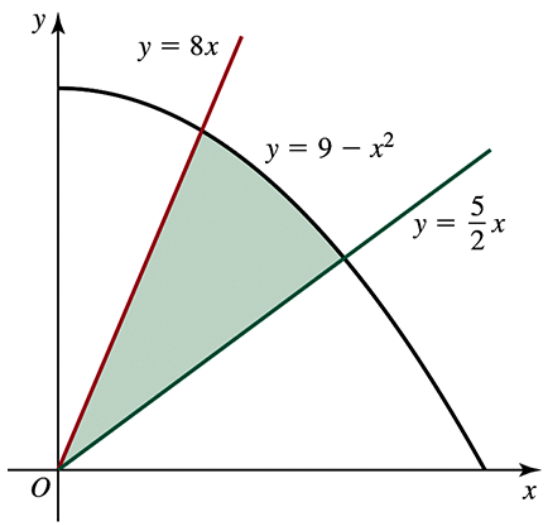
Find the area of the shaded regions in the following figures.
<IMAGE>

Verified step by step guidance
1
Step 1: Identify the boundaries of the shaded region. The shaded region is enclosed by three curves: y = 8x (red line), y = 5/2x (green line), and y = 9 - x^2 (parabola).
Step 2: Determine the points of intersection between the curves. Solve for the x-coordinates where y = 8x intersects y = 9 - x^2 and where y = 5/2x intersects y = 9 - x^2. Set the equations equal to each other and solve for x.
Step 3: Set up the integral to calculate the area. The area is found by integrating the difference between the upper curve (y = 9 - x^2) and the lower curves (y = 8x and y = 5/2x) over their respective intervals. Divide the integral into two parts: one for the interval where y = 8x is the lower curve and another for the interval where y = 5/2x is the lower curve.
Step 4: Write the integral expressions. For the first interval (from x = 0 to the intersection of y = 8x and y = 9 - x^2), the area is given by ∫[0, intersection] (9 - x^2 - 8x) dx. For the second interval (from the intersection of y = 5/2x and y = 9 - x^2 to the intersection of y = 8x and y = 9 - x^2), the area is given by ∫[intersection, intersection] (9 - x^2 - 5/2x) dx.
Step 5: Combine the results of the integrals to find the total area. Evaluate each integral separately and add them together to obtain the total area of the shaded region.

Verified video answer for a similar problem:

This video solution was recommended by our tutors as helpful for the problem above.
Video duration:
4m
Was this helpful?

Key Concepts

Here are the essential concepts you must grasp in order to answer the question correctly.

Definite Integral

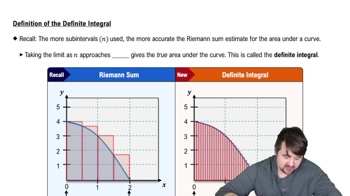
A definite integral calculates the area under a curve between two specified points on the x-axis. It is represented as ∫[a, b] f(x) dx, where f(x) is the function being integrated, and a and b are the limits of integration. This concept is crucial for finding the area of shaded regions in graphs, as it quantifies the total area between the curve and the x-axis over the given interval.
Recommended video:
05:43
Definition of the Definite Integral

Intersection Points

Intersection points are the coordinates where two or more graphs meet. In the context of the given problem, finding these points is essential to determine the limits of integration for the area calculation. By solving the equations of the curves, such as y = 9 - x² and y = 8x, we can identify the x-values that bound the shaded region, allowing for accurate area computation.
Recommended video:
04:50
Critical Points

Area Between Curves

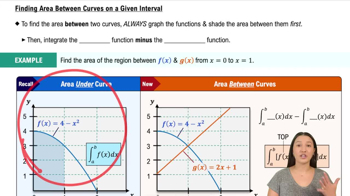
The area between curves is calculated by integrating the difference between the upper function and the lower function over a specified interval. In this case, the area of the shaded region can be found by integrating the difference between the quadratic function and the linear functions that bound it. This concept is vital for accurately determining the area of complex regions formed by multiple curves.
Recommended video:
05:23
Finding Area Between Curves on a Given Interval