Ch. 6 - Applications of Integration
Briggs - Calculus: Early Transcendentals 3rd Edition
Briggs3rd EditionCalculus: Early TranscendentalsISBN: 9780136847243Not the one you use?Change textbook
Chapter 6, Problem 6.3.15

Use the general slicing method to find the volume of the following solids.
The solid whose base is the triangle with vertices (0, 0), (2, 0), and (0, 2), and whose cross sections perpendicular to the base and parallel to the y-axis are semicircles

Verified step by step guidance
1
First, identify the region in the xy-plane that forms the base of the solid. The base is the triangle with vertices at (0,0), (2,0), and (0,2). The boundary lines are the x-axis (y=0), y-axis (x=0), and the line connecting (2,0) to (0,2), which can be expressed as y = 2 - x.
Since the cross sections are taken perpendicular to the base and parallel to the y-axis, we consider slices at a fixed x between 0 and 2. For each x, the cross section is a semicircle whose diameter lies along the y-direction between y=0 and y=2 - x. Therefore, the diameter of the semicircle at position x is the length of the vertical segment from y=0 to y=2 - x, which is (2 - x).
The radius r of the semicircle at position x is half the diameter, so \( r = \frac{2 - x}{2} \). The area A(x) of a semicircle is half the area of a full circle, so \( A(x) = \frac{1}{2} \pi r^2 = \frac{1}{2} \pi \left( \frac{2 - x}{2} \right)^2 \).
To find the volume of the solid, integrate the cross-sectional area A(x) along the x-axis from x=0 to x=2: \[ V = \int_0^2 A(x) \, dx = \int_0^2 \frac{1}{2} \pi \left( \frac{2 - x}{2} \right)^2 \, dx \].
Simplify the integrand before integrating, then evaluate the definite integral to find the volume of the solid.

Verified video answer for a similar problem:

This video solution was recommended by our tutors as helpful for the problem above.
Video duration:
7m
Was this helpful?

Key Concepts

Here are the essential concepts you must grasp in order to answer the question correctly.

General Slicing Method

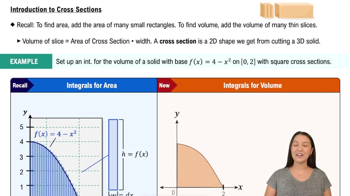
The general slicing method involves finding the volume of a solid by integrating the area of cross-sectional slices taken perpendicular to an axis. Each slice's area is expressed as a function of the variable of integration, and integrating these areas over the given interval yields the total volume.
Recommended video:
07:33
Euler's Method

Equation of the Base Region

Understanding the base region is crucial for setting up the integral limits and the cross-sectional dimensions. Here, the base is a triangle with vertices (0,0), (2,0), and (0,2), which can be described by the line x + y = 2. This equation helps determine the length of the cross sections at each slice.
Recommended video:
4:46
Solving Exponential Equations Using Like Bases

Area of Semicircular Cross Sections

The cross sections perpendicular to the base and parallel to the y-axis are semicircles. The area of a semicircle is half the area of a full circle, given by (πr²)/2, where the radius r depends on the length of the base segment at each slice. Expressing r in terms of the variable of integration is essential for the volume calculation.
Recommended video:
05:38
Introduction to Cross Sections