Ch. 6 - Applications of Integration
Briggs - Calculus: Early Transcendentals 3rd Edition
Briggs3rd EditionCalculus: Early TranscendentalsISBN: 9780136847243Not the one you use?Change textbook
Chapter 6, Problem 6.7.7

What is the pressure on a horizontal surface with an area of 2 m² that is 4 m underwater?

Verified step by step guidance
1
Identify the physical principle involved: Pressure at a certain depth underwater is given by the hydrostatic pressure formula, which accounts for the pressure due to the water column above the surface.
Write down the formula for pressure at depth: \(P = P_0 + \rho g h\), where \(P\) is the total pressure at depth, \(P_0\) is the atmospheric pressure on the surface, \(\rho\) is the density of the water, \(g\) is the acceleration due to gravity, and \(h\) is the depth underwater.
List the known values: \(h = 4\) m (depth), \(\rho \approx 1000\) kg/m³ (density of water), \(g \approx 9.8\) m/s² (acceleration due to gravity), and \(P_0 \approx 101325\) Pa (atmospheric pressure at sea level).
Calculate the hydrostatic pressure component: multiply \(\rho\), \(g\), and \(h\) to find the pressure due to the water column.
Add the atmospheric pressure \(P_0\) to the hydrostatic pressure to find the total pressure on the horizontal surface. Note that the area of the surface does not affect the pressure value, as pressure is force per unit area.

Verified video answer for a similar problem:

This video solution was recommended by our tutors as helpful for the problem above.
Video duration:
3m
Was this helpful?

Key Concepts

Here are the essential concepts you must grasp in order to answer the question correctly.

Pressure in Fluids

Pressure in a fluid at a certain depth is the force exerted per unit area due to the weight of the fluid above. It increases with depth because more fluid is stacked above, creating greater force on the surface below.
Recommended video:
11:50
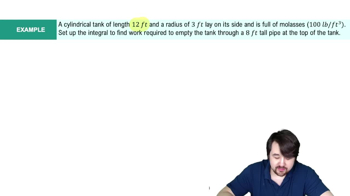
Pumping Liquids Example 5

Hydrostatic Pressure Formula

Hydrostatic pressure is calculated using the formula P = ρgh, where ρ is the fluid density, g is acceleration due to gravity, and h is the depth. This formula helps determine the pressure exerted by a fluid at a given depth.
Recommended video:
Guided course
5:59
Recursive Formulas

Area and Pressure Relationship

Pressure is independent of the surface area on which it acts; it depends only on the fluid properties and depth. The total force on the surface can be found by multiplying pressure by area, but pressure itself remains constant regardless of area size.
Recommended video:
05:06
Finding Area When Bounds Are Not Given