Ch. 6 - Applications of Integration
Briggs - Calculus: Early Transcendentals 3rd Edition
Briggs3rd EditionCalculus: Early TranscendentalsISBN: 9780136847243Not the one you use?Change textbook
Chapter 6, Problem 6.3.46

For the following regions R, determine which is greater—the volume of the solid generated when R is revolved about the x-axis or about the y-axis.


R is bounded by y=4−2x, the x-axis, and the y-axis.

Verified step by step guidance
1
Step 1: Understand the problem. The region R is bounded by the line y = 4 - 2x, the x-axis, and the y-axis. This means the region is a triangular area in the first quadrant. We need to compare the volumes of solids generated when this region is revolved about the x-axis and the y-axis.
Step 2: Set up the integral for the volume when the region is revolved about the x-axis. Use the disk method. The formula for the volume is: Vx=abπy2dx. Substitute y = 4 - 2x into the formula, and determine the limits of integration (x = 0 to x = 2).
Step 3: Set up the integral for the volume when the region is revolved about the y-axis. Use the shell method. The formula for the volume is: Vy=cdπxydy. Express x in terms of y using the equation y = 4 - 2x (solve for x: x = (4 - y)/2), and determine the limits of integration (y = 0 to y = 4).
Step 4: Compare the two integrals. Evaluate the structure of each integral to determine which volume is greater. For the x-axis revolution, the integral involves squaring y = 4 - 2x, while for the y-axis revolution, the integral involves multiplying x = (4 - y)/2 by y. Analyze the behavior of these functions over their respective limits.
Step 5: Conclude which volume is greater based on the comparison of the integrals. You can also calculate the integrals explicitly if needed to confirm the result, but the setup and comparison provide the conceptual understanding required to answer the question.

Verified video answer for a similar problem:

This video solution was recommended by our tutors as helpful for the problem above.
Video duration:
7m
Was this helpful?

Key Concepts

Here are the essential concepts you must grasp in order to answer the question correctly.

Volume of Revolution

The volume of revolution refers to the volume of a solid formed by rotating a two-dimensional region around an axis. This can be calculated using methods such as the disk method or the washer method, depending on whether the region is bounded by curves or lines. Understanding how to set up these integrals is crucial for determining the volume generated by revolving the region R around the x-axis or y-axis.
Recommended video:
04:48
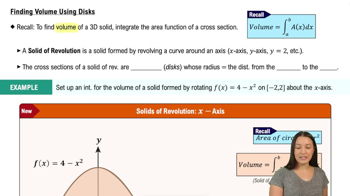
Finding Volume Using Disks

Disk and Washer Methods

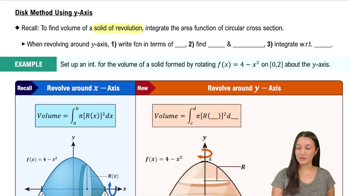
The disk method is used when a region is revolved around an axis, creating a solid with circular cross-sections perpendicular to the axis of rotation. The washer method extends this concept to cases where there is a hole in the center, requiring the calculation of the outer and inner radii. Mastery of these methods allows for accurate volume calculations for solids of revolution.
Recommended video:
06:30
Disk Method Using y-Axis

Bounded Regions and Integration

In calculus, a bounded region is defined by specific curves or lines, which in this case are y=4−2x, the x-axis, and the y-axis. To find the volume of the solid generated by revolving this region, one must first determine the limits of integration based on where these boundaries intersect. This understanding is essential for setting up the correct integrals for volume calculations.
Recommended video:
07:45
Area of Polar Regions