Ch. 6 - Applications of Integration
Briggs - Calculus: Early Transcendentals 3rd Edition
Briggs3rd EditionCalculus: Early TranscendentalsISBN: 9780136847243Not the one you use?Change textbook
Chapter 6, Problem 6.5.17

9–20. Arc length calculations Find the arc length of the following curves on the given interval.
x = y⁴/4 + 1/8y², for 1≤y≤2

Verified step by step guidance
1
Step 1: Recall the formula for arc length of a curve given in parametric form: L = ∫ab √(1 + (dx/dy)2) dy. Here, the curve is given as x = y4/4 + 1/(8y2), and the interval is 1 ≤ y ≤ 2.
Step 2: Compute the derivative dx/dy. Differentiate x = y4/4 + 1/(8y2) with respect to y. Use the power rule and chain rule: dx/dy = y3 - 1/(4y3).
Step 3: Square the derivative dx/dy. This gives (dx/dy)2 = (y3 - 1/(4y3))2. Expand the square if necessary for simplification.
Step 4: Substitute (dx/dy)2 into the arc length formula. The integrand becomes √(1 + (y3 - 1/(4y3))2). Set up the integral: L = ∫12 √(1 + (y3 - 1/(4y3))2) dy.
Step 5: Evaluate the integral. Depending on the complexity of the integrand, you may need numerical methods or advanced techniques to compute the arc length. Ensure proper limits of integration are applied from y = 1 to y = 2.

Verified video answer for a similar problem:

This video solution was recommended by our tutors as helpful for the problem above.
Video duration:
4m
Was this helpful?

Key Concepts

Here are the essential concepts you must grasp in order to answer the question correctly.

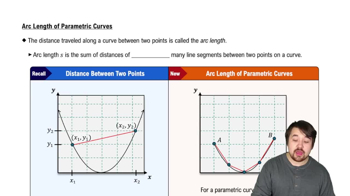
Arc Length Formula

The arc length of a curve defined by a function can be calculated using the formula L = ∫√(1 + (dy/dx)²) dy, where dy/dx is the derivative of the function with respect to y. This formula allows us to find the length of the curve over a specified interval by integrating the square root of one plus the square of the derivative.
Recommended video:
06:29
Arc Length of Parametric Curves

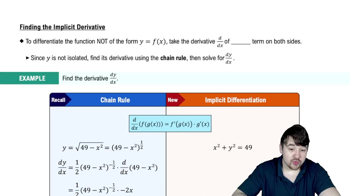
Implicit Differentiation

When dealing with curves defined in terms of y, implicit differentiation is often used to find dy/dx. This technique involves differentiating both sides of an equation with respect to y, treating x as a function of y, which is essential for applying the arc length formula correctly.
Recommended video:
05:14
Finding The Implicit Derivative

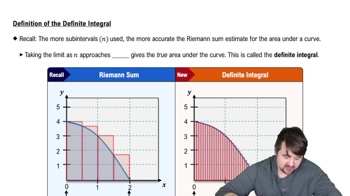
Definite Integrals

Definite integrals are used to calculate the total length of the curve over a specific interval. In this context, the limits of integration correspond to the values of y (from 1 to 2) for which the arc length is being calculated, allowing us to evaluate the integral to find the exact length of the curve.
Recommended video:
05:43
Definition of the Definite Integral